

Businesses with field sales and service teams need accurate location data to make faster decisions and improve daily operations. Salesforce Mapping and Routing helps organizations visualize customer locations, optimize travel routes, simplify territory management, and improve field productivity. Instead of relying on spreadsheets or manual planning, businesses can use map-based insights to reduce travel time, assign resources more effectively, and deliver better customer experiences.
As companies grow, managing field operations becomes more challenging. Sales representatives, service technicians, and managers need real-time visibility into customers, territories, appointments, and travel schedules. Salesforce Mapping and Routing brings these capabilities into one platform, helping teams work more efficiently while making data-driven decisions across every stage of the customer journey. Businesses implementing Salesforce Consulting Services can also identify the right mapping strategy, configure location-based workflows, and align Salesforce with their operational goals.
This guide covers 14 practical ways Salesforce Mapping and Routing can support business growth, grouped into key business areas including Location Intelligence, Field Mobility, Sales Enablement, Territory Management, and Route Planning.
Field Team Mobility
1. Access Salesforce Data Anywhere with Mobile Mapping
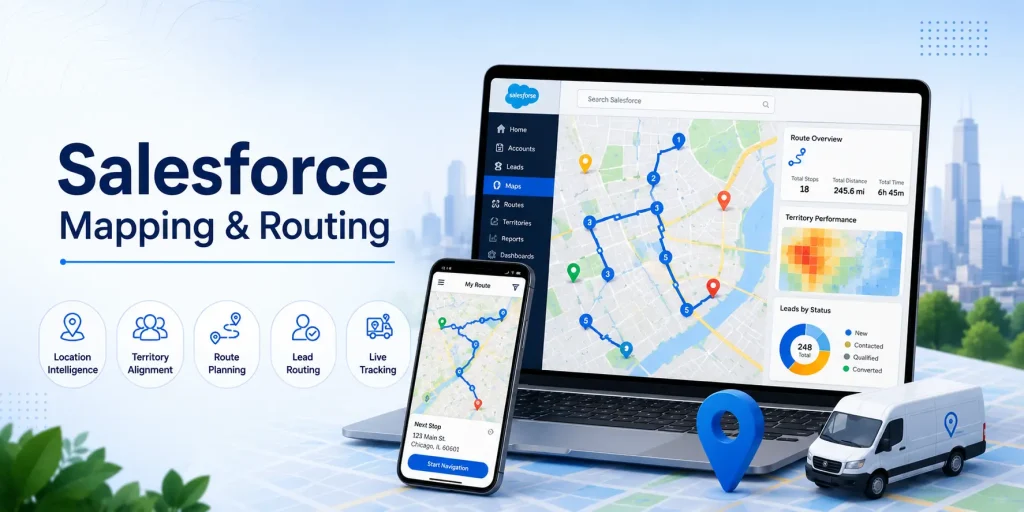
Field teams spend a significant amount of time traveling between customer locations, making meetings, and updating sales activities. Salesforce Mapping and Routing gives representatives access to customer information, account details, appointments, and optimized travel routes directly from their mobile devices. This allows them to work efficiently without returning to the office or switching between multiple applications.
Location-based mapping brings Salesforce records onto an interactive map, helping sales representatives quickly identify nearby customers, scheduled visits, and priority accounts. Managers also gain better visibility into field activities, making it easier to monitor performance, evaluate productivity, and support their teams with accurate operational insights.
With optimized routes available on a smartphone, representatives spend less time planning travel and more time meeting customers. Route optimization reduces unnecessary driving, shortens travel time, and allows teams to complete more customer visits within the same working hours. Businesses using Salesforce Implementation Services can configure mobile mapping features according to their sales process, ensuring every representative has access to the information required while working in the field.
Representatives can update Salesforce records immediately after meetings, synchronize appointments with their schedules, complete customer check-ins, and manage daily activities through a mobile-friendly mapping interface. Keeping customer information updated in real time improves data accuracy and helps every department work from the latest information.
2. Capture More Field Data Directly Inside Salesforce
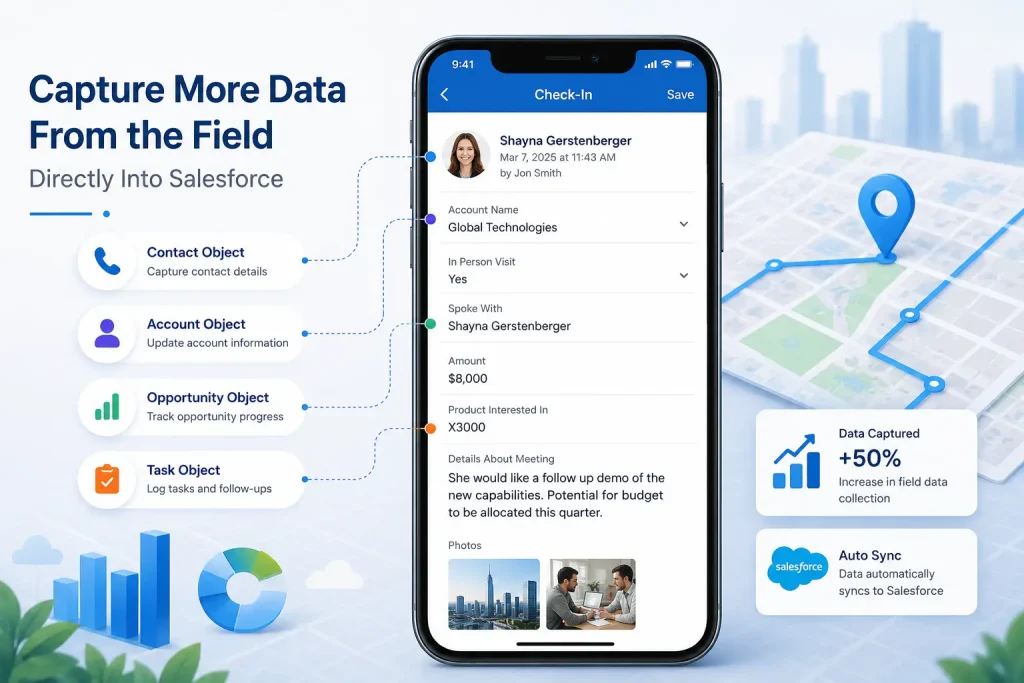
Accurate customer information is one of the most valuable assets in any CRM. Salesforce Mapping and Routing makes it easier for field teams to record customer interactions while they are still on-site, helping businesses maintain complete and reliable CRM records.
Many sales representatives delay updating customer information because they spend most of their day traveling. Notes are often written separately and entered into Salesforce much later, increasing the possibility of missing valuable customer details. A mobile mapping solution removes this challenge by allowing users to update records during customer visits without interrupting their workflow.
Businesses can customize mobile check-in processes to collect important Salesforce data automatically. Representatives can complete forms, upload visit information, record meeting outcomes, and even use speech-to-text functionality to capture notes that synchronize directly with Salesforce. This continuous flow of field information provides marketing teams, operations managers, and business leaders with more complete customer data for reporting and planning.
Better CRM data also supports more informed business decisions. Managers can identify customer trends, monitor sales activities, measure field performance, and improve operational planning based on accurate information collected directly from customer locations.
Enable Your Sales Team
3. Help Sales Representatives Find Better Prospecting Opportunities
Finding qualified prospects becomes easier when customer and location data work together. Salesforce Mapping and Routing allows sales teams to visualize leads on a map, making it easier to identify nearby opportunities and plan visits based on geographic proximity.
Representatives can apply filters to narrow prospects by location, account type, industry, or other Salesforce data, allowing them to prioritize businesses with the highest potential. Instead of spending time searching manually, they can build a structured prospecting plan that improves both efficiency and coverage.
Unexpected schedule changes happen regularly during field visits. Customer cancellations, traffic delays, or meeting rescheduling can create unused time during the day. Mobile mapping allows representatives to quickly locate nearby prospects and schedule additional visits, helping them maintain productivity without changing their entire work schedule.
4. Improve Team Accountability with Location-Based Check-Ins
Sales managers rely on accurate activity records to understand how field teams perform across different territories. Salesforce Mapping and Routing simplifies this process through automated location check-ins and visit tracking.
Each customer visit can be recorded with location, date, and time information, providing reliable activity records without requiring additional manual work. Managers receive better visibility into completed visits, customer interactions, and daily field operations while maintaining standardized reporting across the organization.
Location verification also strengthens compliance with internal sales processes. Automated check-ins reduce reporting errors, improve activity tracking, and provide trusted information that supports performance reviews, territory management, and operational planning.
5. Simplify Mileage Tracking and Expense Management
Administrative tasks reduce the amount of time representatives spend building customer relationships. Mileage tracking is one example where manual calculations often consume valuable working hours, especially for teams visiting multiple customer locations each day.
Salesforce Mapping and Routing automatically calculates travel distance using optimized routes, allowing representatives to record mileage accurately without maintaining separate spreadsheets or rebuilding routes manually. This saves time while improving the accuracy of reimbursement records.
Location verification and digital route history also provide managers with reliable audit information whenever travel expenses need validation. Automated mileage reporting reduces paperwork, improves operational efficiency, and allows field representatives to spend more time serving customers instead of completing administrative tasks.
Location Intelligence
6. Turn Location Data into Better Business Decisions
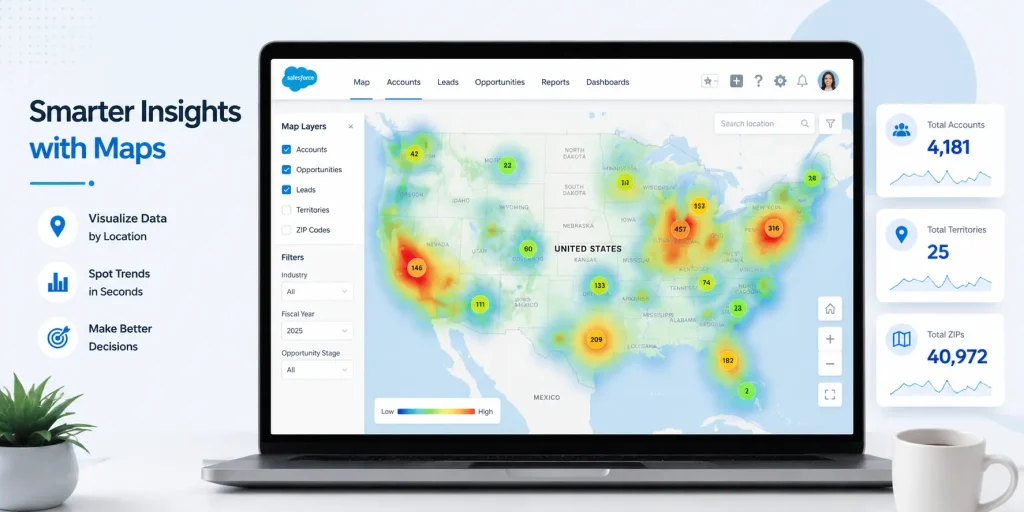
Business growth depends on making decisions backed by reliable data. Salesforce Mapping and Routing gives sales, service, operations, and marketing teams a clear geographic view of customers, territories, and business activities. Instead of reviewing spreadsheets or static reports, decision-makers can visualize customer information on interactive maps and identify patterns that support smarter planning and resource allocation.
An intuitive mapping interface allows businesses to combine Salesforce records with geographic information, making it easier to understand where customers are located, where teams spend their time, and which territories require additional attention. Interactive heat maps and color-coded map layers help organizations compare customer density, sales performance, field activities, and operational trends in one place. This visual approach helps managers evaluate different planning scenarios and allocate resources where they create the greatest business value.
Location intelligence also provides valuable customer insights beyond simple addresses. Businesses can analyze revenue potential, company size, purchasing history, product adoption, recent transactions, customer engagement, and regional buying patterns directly on a map. These insights help organizations improve lead distribution, optimize field operations, and build marketing strategies based on accurate geographic data. Companies implementing Salesforce Integration Services can connect Salesforce with mapping platforms, external data sources, and business applications to create a unified location intelligence solution.
7. Help Sales Teams Focus on High-Value Opportunities
Sales teams achieve better results when they know which accounts deserve the highest priority. Salesforce Mapping and Routing allows sales leaders and representatives to evaluate customer locations alongside important Salesforce data, helping them focus their time on opportunities with the greatest revenue potential.
Advanced mapping tools allow representatives to filter accounts using business information such as opportunity value, customer engagement, previous interactions, lead scores, industry, or proximity to a specific location. These filters make daily planning more effective by helping representatives organize customer visits according to business priorities instead of travel convenience alone.
Managers can also identify strategic accounts that require immediate follow-up while helping representatives balance their territories more effectively. Visual mapping makes it easier to recognize underserved areas, locate nearby prospects, and prioritize customers with the highest growth potential.
Access to geographic customer insights also strengthens sales conversations. Representatives can identify nearby successful customer implementations, evaluate regional demand, and prepare more personalized engagement strategies. Better visibility into territory performance allows sales teams to improve conversion rates while making more efficient use of their available time.
8. Make Smarter Marketing Decisions with Geographic Insights
Marketing campaigns become more effective when businesses understand where their customers are located and how different regions respond to their messaging. Salesforce Mapping and Routing helps marketing teams analyze geographic customer data so campaigns can be planned using real business insights instead of assumptions.
By combining Salesforce customer information with demographic, property, industry, and market data, marketers gain a deeper understanding of customer behavior across different locations. This makes it easier to identify high-potential markets, build targeted audience segments, and improve campaign performance through location-based planning.
Businesses can also create audience lists based on geographic distance, customer attributes, purchasing behavior, or engagement history. These audiences can be synchronized with Salesforce Campaigns, Marketing Cloud, or Account Engagement (Pardot) to deliver personalized emails, event invitations, and promotional communications that are relevant to each customer segment.
Location analytics also supports event planning and regional marketing initiatives. Marketing teams can identify areas with high opportunity value, organize local campaigns, prioritize regional investments, and coordinate field marketing activities based on customer concentration and business potential. Using geographic intelligence alongside Salesforce data allows organizations to improve campaign performance, increase customer engagement, and support long-term business growth with informed marketing decisions.
Align and Design Sales and Service Territories
9. Optimize Territory Alignment for Better Sales Performance
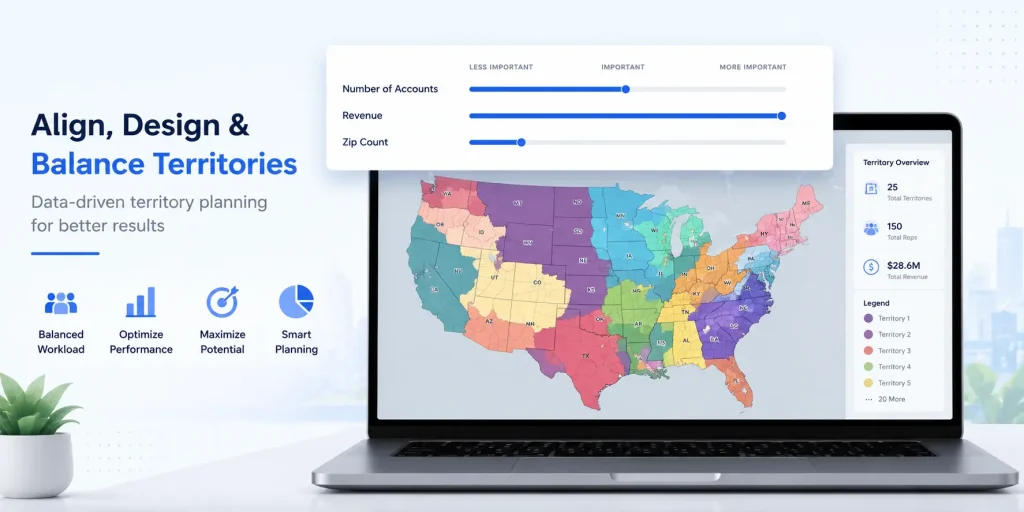
Well-planned territories help field sales and service teams work more efficiently while improving customer coverage. Salesforce Mapping and Routing enables businesses to create balanced territories based on customer distribution, revenue potential, geographic boundaries, account volume, and future business opportunities. Whether an organization manages 20 representatives or hundreds across multiple regions, intelligent territory planning helps ensure every team member is assigned a fair and manageable workload.
Successful field operations begin with territory structures that support business goals. Many organizations still rely on spreadsheets to divide territories, but manual planning often creates uneven workloads, overlapping regions, and inefficient customer assignments. As businesses expand, new customers, employees, and service locations make these manual territory plans difficult to maintain. This can result in delayed customer responses, reduced productivity, and inconsistent service quality.
Salesforce Mapping and Routing simplifies territory planning through interactive map-based visualization and analytics. Managers can review territory performance, compare customer distribution, evaluate workload balance, and redesign territories using real business data. Different planning scenarios can be tested before assigning accounts or updating ownership within Salesforce, allowing organizations to adapt quickly as business requirements change. Businesses using Salesforce Custom Development Services can further customize territory management processes, automate assignment rules, and build solutions that match their unique sales structure.
Organizations can also create territory models using custom business metrics such as representative experience, product specialization, customer priority, account value, workload capacity, travel distance, or active sales opportunities. These factors allow managers to build territories that improve operational efficiency while supporting both customer satisfaction and revenue growth.
A data-driven approach to territory alignment creates long-term benefits for sales and service teams. Balanced territories reduce conflicts between representatives, improve customer coverage, simplify resource planning, and help businesses respond more quickly to changing market conditions. With Salesforce Mapping and Routing, organizations can build territory strategies that improve team productivity while creating stronger opportunities for sustainable business growth.
Lead Routing
10. Assign Leads to the Right Sales Representative Automatically
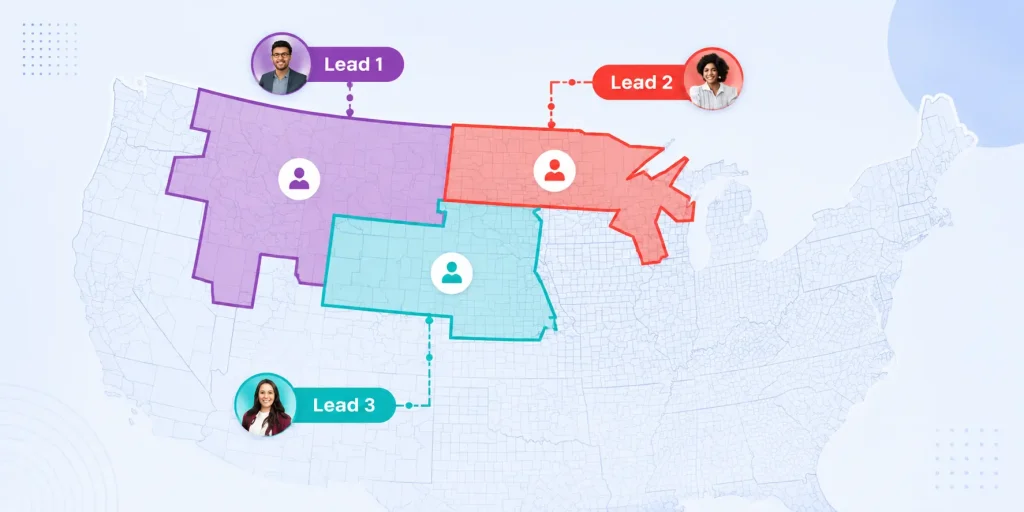
Businesses with field sales teams need a lead assignment process that matches customers with the right representative based on geographic territory. Salesforce Mapping and Routing automates this process by identifying where a new lead is located, matching it with the appropriate territory, and assigning it to the correct sales representative without manual intervention. Faster lead distribution allows businesses to respond quickly, increasing the chances of converting potential customers before competitors do.
Manual lead assignment often slows down the sales process, especially for organizations managing multiple territories and a growing customer base. Sales managers may spend valuable time reviewing each lead, identifying territory ownership, and forwarding opportunities to representatives. Salesforce Mapping and Routing removes these repetitive tasks by using location-based automation to distribute leads instantly while maintaining accurate territory ownership.
Businesses can also create intelligent assignment rules based on company size, opportunity value, product category, industry, customer type, or any custom Salesforce field. This flexibility allows organizations to assign enterprise opportunities to senior representatives, distribute specialized products to experienced teams, or divide opportunities within the same territory according to business priorities. Companies implementing Salesforce Sales Cloud Services can further automate lead qualification, assignment rules, and sales workflows to improve response time and conversion rates.
Automated geographic lead routing improves operational efficiency, reduces manual work, and ensures every new opportunity reaches the most suitable representative without unnecessary delays.
Route Planning
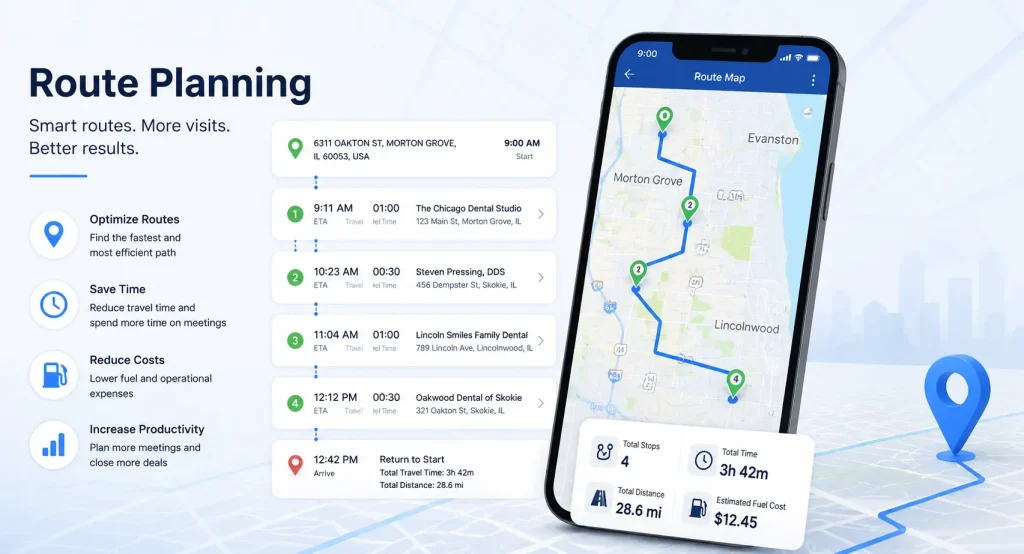
11. Plan and Optimize Customer Routes More Efficiently
Daily travel planning directly affects the productivity of field sales and service teams. Salesforce Mapping and Routing helps representatives create optimized multi-stop routes that reduce travel time, lower fuel expenses, and increase the number of customer visits completed during the day.
By combining customer locations with Salesforce account data, representatives can organize visits based on account priority, appointment schedules, service windows, travel distance, and business objectives. Instead of manually planning every trip, route optimization automatically builds efficient travel schedules that support better time management and improved customer coverage.
Advanced routing capabilities also allow organizations to apply business rules such as visit frequency, preferred appointment windows, customer priority levels, and recurring service schedules. Representatives can adjust their routes directly from their mobile devices whenever meetings are canceled, traffic conditions change, or new opportunities become available nearby. This flexibility helps field teams remain productive throughout the day while maximizing customer engagement and overall sales performance.
12. Dispatch the Right Representative at the Right Time
Managing field operations requires more than assigning the nearest employee. Dispatch teams must consider representative skills, territory coverage, product expertise, equipment availability, customer requirements, and scheduling commitments before making assignments. Salesforce Mapping and Routing provides a centralized geographic view that helps managers dispatch the most suitable representative for every service request.
Real-time mapping allows dispatchers to monitor representative locations, territory boundaries, customer addresses, and travel progress within a single interface. This visibility enables faster scheduling decisions while improving response times and customer satisfaction.
Managers can also build dispatch strategies using Salesforce data such as appointment windows, service-level agreements (SLAs), workload capacity, business priorities, and resource availability. Planned routing helps reduce unnecessary travel, balance workloads across teams, and improve operational efficiency throughout the organization. Businesses using Salesforce Field Service Implementation Services can further enhance scheduling, workforce management, and dispatch automation by integrating mapping capabilities with Field Service operations.
13. Improve Field Operations with Live Location Tracking
Real-time location tracking gives managers continuous visibility into field operations, allowing them to monitor representative movements, optimize schedules, and respond quickly to changing situations. Salesforce Mapping and Routing provides accurate location updates that support faster decision-making across sales, service, and fleet management teams.
Managers can view representative locations, estimate arrival times, monitor time spent at customer sites, update work orders, automate customer notifications, and respond to unexpected delays without interrupting field operations. Real-time visibility also improves communication between dispatchers and field representatives, helping organizations deliver a more consistent customer experience.
For businesses managing vehicles or physical assets, live tracking simplifies asset monitoring by identifying equipment locations, confirming active usage, locating misplaced assets, and scheduling maintenance based on operational data. Mileage reporting also becomes more accurate because travel information is recorded automatically throughout the workday.
These capabilities provide greater operational control while supporting better planning, improved resource utilization, and faster responses across every field activity.
14. Strengthen Asset Management with Geofencing and Automated Alerts
Monitoring field assets becomes easier when businesses receive automatic notifications based on location. Salesforce Mapping and Routing uses geofencing technology to create virtual geographic boundaries around service areas, territories, warehouses, customer sites, or operational zones.
Whenever vehicles, equipment, or representatives enter or leave predefined areas, managers can receive automatic alerts without continuously monitoring operations. These notifications help organizations maintain operational standards, improve compliance, and quickly identify unexpected movement outside approved service regions.
Geofencing also supports better resource management by helping businesses protect valuable assets, monitor territory coverage, and verify that field activities follow company guidelines. Managers can enable or disable live tracking based on work schedules, balancing operational visibility with employee privacy requirements. Together, automated alerts and geofencing improve oversight while helping organizations maintain efficient, well-managed field operations.
Final Thoughts
Salesforce Mapping and Routing provides practical solutions that help businesses improve field sales, service operations, territory planning, lead management, and route optimization. Throughout this guide, we have covered 14 ways organizations can use location intelligence and mapping capabilities to improve productivity, strengthen customer engagement, and make more informed business decisions. Whether you manage sales representatives, field service technicians, operations teams, or business leaders, mapping technology helps every role work with greater accuracy and efficiency.
Different Salesforce mapping solutions support different business requirements. Some platforms focus on mobile mapping, route optimization, lead routing, and territory management for field sales teams, while others provide advanced geographic analytics, marketing insights, dispatch management, fleet visibility, and service operations. Selecting the right solution depends on your business goals, operational structure, and customer engagement strategy. Organizations working with Salesforce Managed Services can continuously optimize these solutions, monitor performance, and adapt configurations as business requirements evolve.
By combining Salesforce data with intelligent mapping capabilities, businesses gain better visibility into customers, territories, assets, and field activities. These insights help reduce operational costs, improve resource allocation, shorten response times, and support more effective decision-making across departments. When implemented correctly, Salesforce Mapping and Routing becomes an important part of a connected CRM strategy that drives long-term business growth while helping organizations deliver faster, more personalized customer experiences.
Frequently Asked Questions
1. What is Salesforce Mapping and Routing?
Salesforce Mapping and Routing is a solution that helps businesses visualize customer locations, optimize travel routes, manage sales territories, and assign leads based on geographic data. It helps field teams work more efficiently while improving customer coverage and response time.
2. What are the benefits of Salesforce Mapping and Routing?
Salesforce Mapping and Routing helps reduce travel time, improve route planning, automate lead assignment, balance sales territories, increase field productivity, and provide location-based insights that support better business decisions.
3. How does Salesforce Mapping and Routing improve field sales performance?
Field sales representatives can view customer locations, plan optimized routes, update Salesforce records from mobile devices, and schedule more customer visits in less time. This helps improve productivity and customer engagement.
4. Can Salesforce Mapping and Routing automate lead assignment?
Yes. Salesforce Mapping and Routing automatically assigns leads based on geographic territories and business rules such as industry, company size, product type, or opportunity value. This helps sales teams respond to new leads much faster.
5. Is Salesforce Mapping and Routing useful for service teams?
Yes. Service teams can use Salesforce Mapping and Routing to dispatch technicians, optimize service routes, monitor field activities, and improve response times while reducing operational costs.
6. How does Salesforce Mapping and Routing support territory management?
It helps businesses create balanced sales and service territories based on customer locations, revenue potential, account distribution, workload, and geographic boundaries. This improves resource allocation and territory planning.
7. Can Salesforce Mapping and Routing work with Salesforce Field Service?
Yes. Salesforce Mapping and Routing can be integrated with Salesforce Field Service to improve technician scheduling, dispatch management, live location tracking, and route optimization for field operations.
8. Why choose iBirds Services for Salesforce Mapping and Routing implementation?
iBirds Services provides Salesforce consulting, implementation, customization, integration, and ongoing support to help businesses build a Salesforce Mapping and Routing solution that matches their business processes and long-term growth goals.