

Maintaining clean Salesforce data is one of the biggest responsibilities for every Salesforce Admin. Duplicate records, missing customer information, inaccurate addresses, and outdated contact details can create reporting errors, reduce campaign performance, and affect customer relationships. Even with validation rules and regular data cleanup, these issues often return as business data continues to change.
One challenge that many organizations overlook is keeping customer addresses up to date. A record may appear accurate when it is created, but customers can relocate, update their business location, or change mailing addresses over time. Without regular address updates, companies may continue sending invoices, marketing materials, or important communications to incorrect locations, leading to unnecessary costs and missed business opportunities.
This is why standard address validation alone is no longer enough. Businesses need a Salesforce-native approach that not only verifies address accuracy but also helps maintain complete, correct, and current customer data. With the right Salesforce Consulting Services, organizations can build reliable data management processes that improve data quality, support automation, and help teams make better business decisions using trusted Salesforce records.
The Hidden Cost of “Clean Enough” Salesforce Data
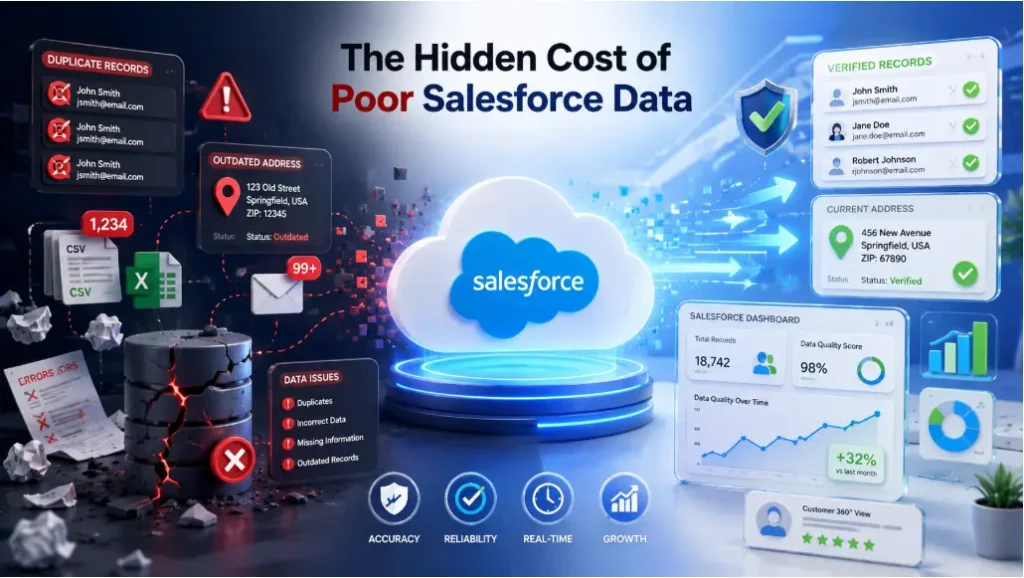
Many Salesforce teams spend significant time creating validation rules, standardizing address formats, and using data quality tools to verify customer records. These practices help ensure that street names, cities, states, postal codes, and other address fields are entered correctly. While this improves data accuracy, it does not guarantee that the information will remain accurate over time.
The real challenge begins when customer information changes. People relocate, businesses open new offices, and mailing addresses are updated regularly. If these changes are not reflected in Salesforce, records that once appeared accurate can quickly become outdated, affecting sales, service, and marketing activities across the organization.
Outdated address data can create several business problems, including:
- Returned mail and unnecessary marketing expenses.
- Missed customer renewal opportunities and follow-up communications.
- Delivery delays for invoices, contracts, or important business documents.
- AI models and Salesforce reports generating insights from outdated customer information.
Maintaining accurate customer records requires more than a one-time verification process. Businesses should continuously monitor and update Salesforce data to ensure every department works with reliable information. With Salesforce Data Management Services, organizations can automate data quality processes, reduce manual effort, and keep customer records accurate as business information changes.
The Third Element of Clean Salesforce Data: Keeping Information Current
High-quality Salesforce data should always meet three important standards: it should be complete, correct, and current. Most data validation tools can confirm whether an address or customer record follows the correct format and contains the required information. However, maintaining current customer data is often the biggest challenge for Salesforce teams.
Customer information changes continuously. People move to new locations, companies relocate offices, contact details are updated, and business accounts change over time. Without a process to capture these updates, Salesforce records gradually become outdated, even if they were accurate when they were first created. As a result, sales, marketing, and customer service teams may rely on information that no longer reflects real customer data.
Many organizations still depend on manual exports, spreadsheets, or external applications to update customer records. These additional processes increase administrative work, create data synchronization issues, and make it difficult to maintain a single source of truth inside Salesforce. By implementing Salesforce Integration Services, businesses can automate data synchronization, reduce manual updates, and keep Salesforce records accurate, current, and ready to support business operations.
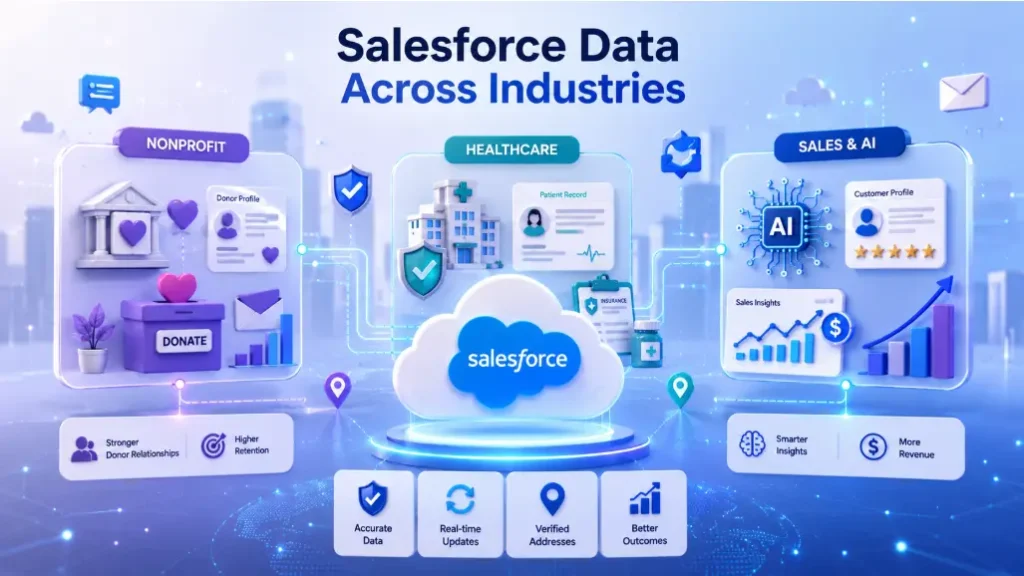
Why Current Salesforce Data Matters Across Industries
Nonprofit Organizations
For nonprofit organizations, accurate customer and donor data plays a major role in fundraising success. Donation campaigns, membership renewals, event invitations, and printed communications depend on correct mailing information. When donor records become outdated, organizations may lose valuable engagement opportunities and spend more on unsuccessful outreach. With Salesforce Sales Cloud Services, nonprofits can maintain reliable donor data and improve communication with supporters.
Healthcare
Healthcare providers also depend on accurate patient and member information. Incorrect addresses can affect billing, insurance claims, appointment reminders, regulatory compliance, and patient communications. Even a small data error may delay important processes or create additional administrative work. Keeping Salesforce records current helps healthcare organizations improve operational efficiency and deliver better patient experiences.
Sales and AI
Sales teams and AI-powered business insights are only as reliable as the data stored in Salesforce. When customer information changes without being updated, sales representatives may miss buying opportunities, while AI models generate recommendations based on outdated records. Current customer data enables better lead management, more accurate forecasting, personalized customer engagement, and smarter business decisions. Using Salesforce AI Services helps organizations combine trusted data with intelligent automation to improve sales performance and customer experiences.
The Salesforce Admin’s Data Management Challenge
Many Salesforce Admins have experienced the frustration of manually maintaining customer data. Tasks such as comparing spreadsheets, importing CSV files, running Data Loader operations, correcting duplicate records, and validating customer information can consume valuable time. Even after completing these activities, customer records can become outdated again as business information changes.
To maintain reliable Salesforce data, organizations need an automated process that keeps customer records accurate without relying on repetitive manual work or disconnected third-party workflows. Reducing manual intervention also lowers the risk of data inconsistencies and helps protect relationships between Salesforce records.
A Smarter Way to Maintain Salesforce Data Quality
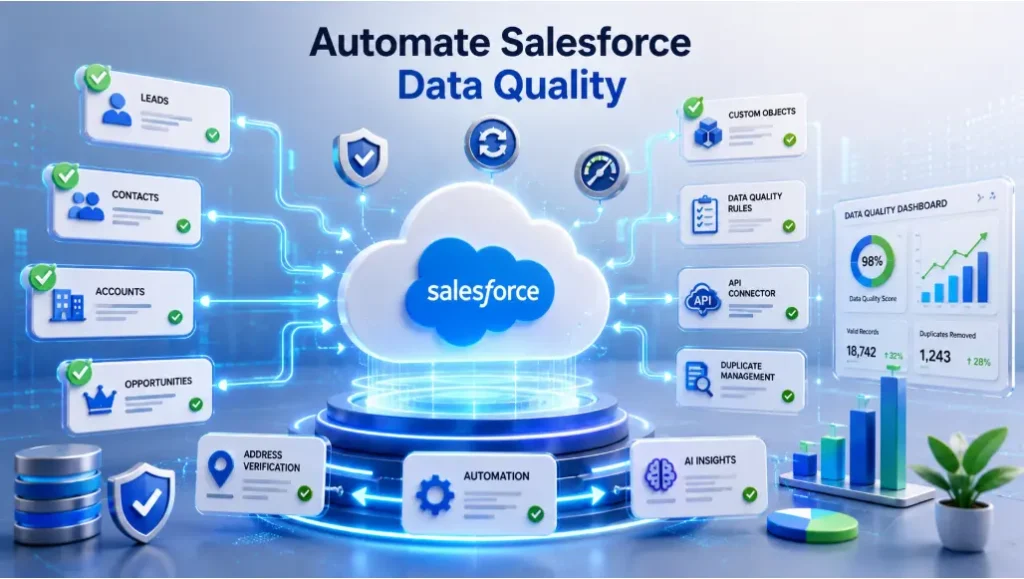
Businesses can simplify Salesforce data management by implementing solutions that automate address validation, customer record updates, and data quality monitoring. Instead of relying on periodic manual cleanups, automated processes help ensure customer information remains complete, accurate, and current throughout its lifecycle.
A modern Salesforce data management solution can provide several advantages, including:
- Automatic updates for customer information when verified records change.
- Continuous address validation to improve mailing accuracy and customer communication.
- Easy synchronization of Leads, Contacts, Accounts, and Custom Objects without complex manual processes.
- Fast implementation that integrates with existing Salesforce environments while reducing administrative effort.
The result is a Salesforce environment that requires less manual maintenance and delivers more reliable business data. Marketing campaigns reach the right customers, sales teams work with accurate information, service agents receive updated customer records, and AI-driven insights are based on trusted Salesforce data. With Salesforce Service Cloud, businesses can continuously monitor data quality, automate routine administration, and keep Salesforce performing efficiently as data grows.
Turning Salesforce Data Quality Into Business Growth
Maintaining clean Salesforce data is not only about improving record accuracy. It also creates new opportunities for sales, marketing, customer service, and business operations. When Salesforce records reflect current customer information, organizations can launch timely renewal campaigns, deliver personalized communications, improve customer engagement, and make faster business decisions based on reliable data.
Adding continuous data maintenance to your Salesforce strategy helps transform outdated records into valuable business assets. Instead of reacting to data quality issues after they affect operations, businesses can proactively maintain accurate customer information that supports better forecasting, automation, reporting, and long-term customer relationships.
Take the Next Step
If your organization focuses only on validating customer records during data entry, important information can gradually become outdated. A complete Salesforce data quality strategy should include ongoing data validation, regular record updates, and automated data management processes to ensure customer information remains complete, correct, and current.
At iBirds Services, we help organizations build reliable Salesforce environments with automated data quality solutions, integrations, and ongoing optimization. Whether you want to improve customer data, streamline Salesforce administration, or automate business processes, our team can help you create a scalable Salesforce solution that supports long-term business growth. With our Salesforce Support Services, you can maintain trusted Salesforce data, reduce manual effort, and maximize the value of your Salesforce investment.
Ready to improve your Salesforce data quality? Contact iBirds Services to discuss your Salesforce requirements and build a smarter, more reliable CRM environment.
Frequently Asked Questions
1. What is Salesforce data quality?
Salesforce data quality refers to maintaining customer records that are complete, accurate, consistent, and up to date. High-quality Salesforce data helps businesses improve reporting, automation, customer communication, and decision-making.
2. Why is clean Salesforce data important for businesses?
Clean Salesforce data reduces duplicate records, incorrect customer information, and outdated addresses. It improves marketing campaigns, sales performance, customer service, and overall CRM efficiency while helping teams make decisions based on reliable data.
3. What are the biggest causes of poor Salesforce data quality?
Common causes include duplicate records, manual data entry errors, outdated customer information, missing fields, inconsistent formatting, and disconnected third-party systems that fail to synchronize data properly.
4. How can businesses improve Salesforce data quality?
Businesses can improve Salesforce data quality by using validation rules, duplicate management, automated data updates, regular data audits, and Salesforce integrations that keep customer records accurate and current without manual effort.
5. Why do customer addresses become outdated in Salesforce?
Customer addresses change when people relocate, businesses move offices, or contact information is updated. Without continuous data maintenance, Salesforce records can quickly become outdated even if they were accurate when originally entered.
6. How does Salesforce data quality affect AI and reporting?
AI models and Salesforce reports rely on accurate customer data. Outdated or incorrect records can produce unreliable insights, inaccurate forecasts, and poor business decisions that affect sales, marketing, and customer service performance.
7. What are the benefits of automating Salesforce data management?
Automated Salesforce data management reduces manual work, improves record accuracy, eliminates duplicate entries, keeps customer information updated, and helps organizations maintain a trusted source of business data.
8. How can Salesforce Integration Services improve data quality?
Salesforce Integration Services automatically synchronize customer data between Salesforce and other business applications. This helps organizations reduce data inconsistencies, improve record accuracy, and maintain current customer information across multiple systems.
9. What is the difference between address validation and address management in Salesforce?
Address validation checks whether an address is correctly formatted and complete, while address management focuses on keeping customer addresses updated over time. Both are important for maintaining accurate Salesforce data.
10. How can iBirds Services help improve Salesforce data quality?
iBirds Services helps businesses improve Salesforce data quality through CRM implementation, data management, system integrations, automation, managed services, and ongoing Salesforce optimization. These solutions help organizations maintain clean, reliable, and current customer data while reducing manual administrative work.