

Artificial Intelligence has become an important part of modern Salesforce solutions. With Salesforce Agentforce, organizations can automate business processes, improve service delivery, and support teams with intelligent AI agents. However, many businesses are still unsure where to begin. While AI adoption is becoming a priority, selecting the right starting point and creating measurable business outcomes often remains the biggest challenge.
This guide shares five practical strategies for a successful Salesforce Agentforce Implementation based on proven implementation practices. These recommendations help organizations introduce AI gradually while creating long-term business value across Salesforce environments.
5 Tips to Kickstart Salesforce Agentforce
Organizations that achieve success with Agentforce usually begin with small, measurable improvements before expanding AI across multiple business functions. The following recommendations provide a structured approach to implementing Salesforce Agentforce while minimizing complexity and improving adoption.
1. Start Small with a Salesforce Agentforce Proof of Concept
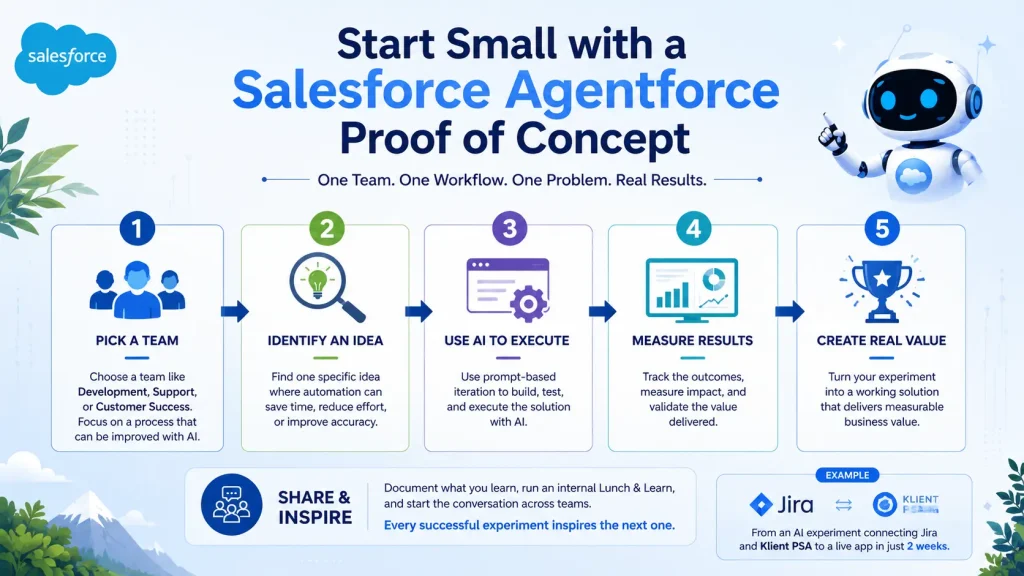
The most effective way to begin a Salesforce Agentforce Implementation is by focusing on a single business process instead of redesigning every workflow simultaneously. Select one department, one repetitive task, and one measurable business objective. A clearly defined Proof of Concept (POC) allows organizations to evaluate AI performance before expanding to larger initiatives. Businesses planning their AI strategy often begin with Salesforce Consulting Services to identify suitable use cases and implementation priorities.
An effective Proof of Concept should include three key elements:
- Select one business team, such as Sales, Customer Support, or Project Delivery.
- Identify a repetitive task where AI can improve efficiency or accuracy.
- Measure the business impact using controlled testing and continuous refinement.
Many organizations begin with internal automation projects before expanding AI across the business. A simple experiment, such as automating project updates, generating service summaries, or synchronizing information between connected systems, can quickly demonstrate measurable operational improvements. Small implementation projects also reduce risk while allowing teams to build practical AI experience.
After completing the initial implementation, document the results, share the outcomes internally, and encourage other departments to evaluate similar AI opportunities. Early success often creates momentum for larger Salesforce Agentforce initiatives.
2. Prepare Your Salesforce Data for Intelligent AI Agents
Successful AI adoption depends on reliable business data. Before expanding any Salesforce Agentforce Implementation, organizations should ensure their Salesforce records, project information, customer data, and operational processes remain complete, organized, and connected. AI systems deliver accurate responses only when they have access to trusted information.
Every AI interaction is typically supported by four essential components:
- Prompt: The request submitted by the user.
- Instruction: The rules that control how the AI responds.
- Knowledge: Trusted documentation, policies, FAQs, and business information.
- Operational Data: Live Salesforce records that provide current business context.
When these four elements work together, AI produces responses that are accurate, consistent, and relevant to business operations.
Organizations should prioritize data quality before deploying intelligent agents. When customer records, project information, communication history, and business documentation exist within a connected Salesforce environment, AI agents perform with greater accuracy and reliability. Strong data management creates a solid foundation for long-term Salesforce Agentforce success.
3. Build AI Agents That Support Daily Salesforce Operations
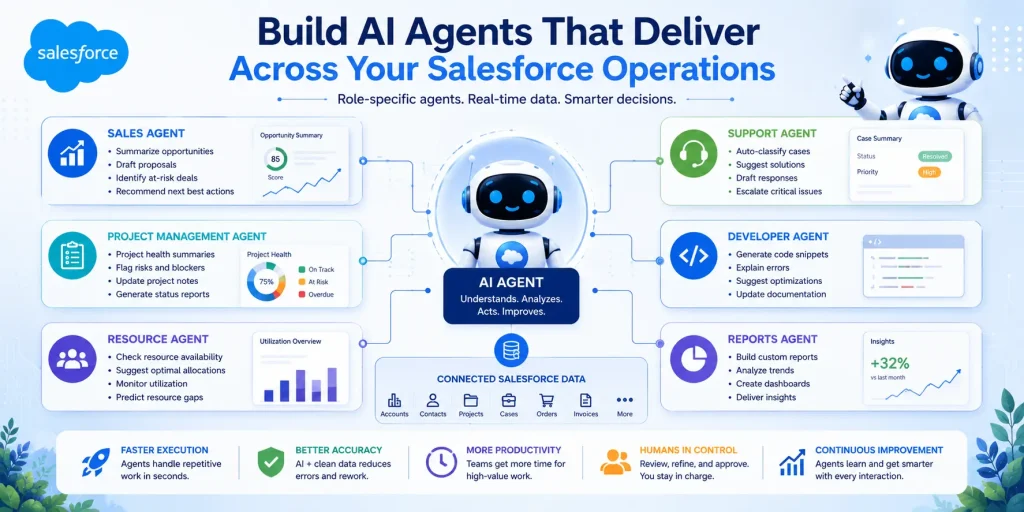
Once the initial implementation delivers positive results, the next step is expanding AI into multiple business scenarios. Rather than relying on a single AI model, organizations should create specialized agents that support different business functions throughout Salesforce.
For example, AI agents can:
- Generate project status summaries.
- Prepare client communication updates.
- Assist support teams with case management.
- Create operational reports from Salesforce data.
Imagine a project manager requesting a summary of active projects requiring immediate attention. Within seconds, an AI agent reviews project records, identifies overdue activities, summarizes client updates, and prepares an internal report for management review. These role-specific agents help employees make faster decisions while improving overall productivity.
Instead of building one large AI solution, organizations achieve better results by creating multiple focused agents that continuously improve through regular monitoring and feedback. Begin with one internal AI agent, evaluate its performance, refine its responses, and gradually expand into additional business processes.
4. Automate Business Processes with Purpose
Automation delivers the greatest value when it improves everyday business operations instead of automating tasks without a clear objective. A successful Salesforce Agentforce Implementation should focus on repetitive activities that consume valuable employee time but contribute little strategic value.
Some practical AI automation opportunities include:
- Creating project status summaries.
- Capturing meeting notes and generating action items.
- Classifying and routing customer support cases.
- Managing invoice approvals and business workflows.
Well-planned automation strengthens employee productivity instead of replacing human expertise. AI agents handle repetitive operational tasks while business users continue reviewing, validating, and approving important decisions. This balance improves efficiency without reducing business control.
As organizations expand AI across Salesforce, governance becomes increasingly important. Every automated process should remain transparent, traceable, and aligned with company policies. Businesses implementing Salesforce Consulting Services in Dubai, UAE often establish governance frameworks that define how employees and AI agents collaborate while maintaining accountability across business operations.
The future of Salesforce automation combines human decision-making with AI-driven execution. Employees continue managing strategy, customer relationships, and business priorities, while intelligent agents complete repetitive operational work in the background.
The result is faster execution, fewer manual errors, improved consistency, and more time for teams to focus on higher-value business activities.
5. Choose AI-Ready Salesforce Solutions
Organizations do not need to build every AI capability from the ground up. Selecting Salesforce solutions that already support intelligent automation significantly reduces implementation complexity and accelerates adoption.
When business information is distributed across disconnected platforms, AI systems struggle to generate reliable recommendations. Organizations operating on a unified Salesforce environment are better positioned to introduce Agentforce because business data, customer information, projects, and operational records already exist within a connected ecosystem.
As Salesforce Agentforce becomes part of daily operations, teams can interact with AI using simple business requests such as:
- Which projects require immediate attention this week?
- Which resources have available capacity?
- Which customer invoices remain unpaid?
- How can project profitability be improved?
- Which business processes should be prioritized for automation?
These interactions demonstrate how intelligent agents support faster decision-making by analyzing live Salesforce data and providing meaningful operational insights.
Rather than treating AI as an additional application, organizations should build their technology strategy around Salesforce-native capabilities. Businesses using Salesforce Integration Services can connect business applications, centralize operational data, and create a stronger foundation for Salesforce Agentforce. A unified platform allows intelligent agents to access trusted information, deliver more accurate recommendations, and support long-term AI adoption across multiple business functions.
From Hype to Habit: Your 30-Day AI Starter Plan
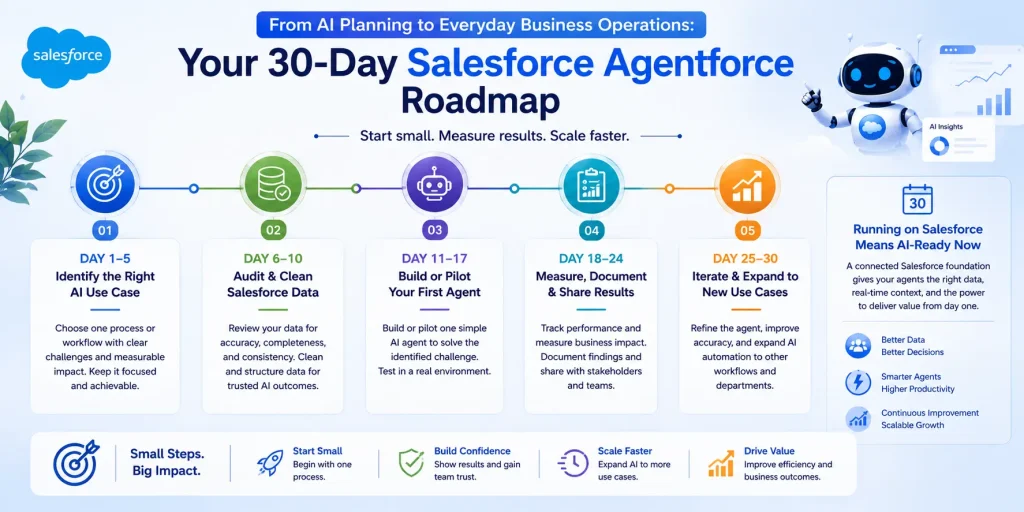
A successful Salesforce Agentforce Implementation begins with small, measurable improvements that gradually expand into organization-wide AI adoption. Instead of trying to automate every business process immediately, organizations should focus on practical use cases that deliver measurable business value. Once early success is achieved, AI initiatives become easier to scale across additional departments and workflows.
Here is a practical roadmap to begin your Salesforce Agentforce journey with a structured implementation approach.
Your First 30 Days
- Select one business process that can benefit from AI-powered automation.
- Review, organize, and improve the Salesforce data supporting that process.
- Build or pilot one AI agent to solve a specific operational challenge.
- Measure the results, document business improvements, and share them across teams.
- Refine the implementation, monitor performance, and gradually expand Agentforce into additional business functions.
Organizations running their operations on Salesforce already have a strong foundation for AI adoption. With connected business data and well-defined processes, intelligent agents can begin supporting day-to-day operations without requiring major system changes.
The growing adoption of Salesforce Agentforce represents more than another technology initiative. It reflects a broader shift from manual business operations toward intelligent, AI-assisted workflows. As organizations continue improving their Salesforce environments, AI agents will become a natural part of project delivery, customer service, sales operations, and internal collaboration. Businesses that begin with small implementations, strengthen their data quality, and continuously improve automation will be better positioned for long-term success. Employees will continue leading strategic decisions and customer relationships while intelligent agents manage repetitive operational activities more efficiently.
Build Salesforce Agentforce Into Every Business Workflow
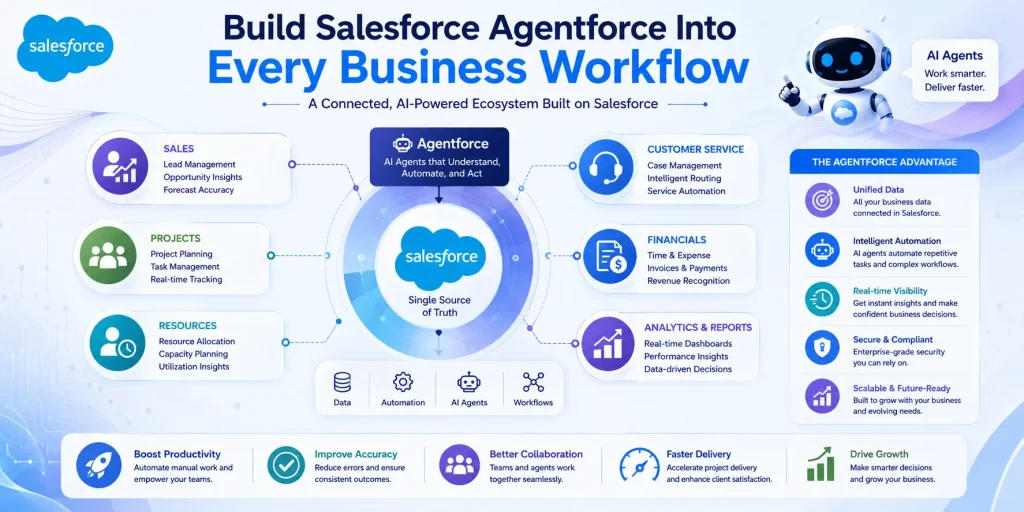
A successful Salesforce Agentforce Implementation depends on a centralized Salesforce environment where projects, customer records, resources, business processes, and operational data work together within a single platform. This connected ecosystem provides intelligent agents with the reliable information needed to automate workflows, improve decision-making, and support business growth.
Organizations using Salesforce Support Services can continuously optimize Agentforce after deployment by monitoring AI performance, refining business processes, and maintaining data quality as operational requirements evolve. Combined with real-time visibility and AI-driven automation, Salesforce Agentforce helps businesses create more efficient delivery processes while maintaining full control over business operations.
The future of Salesforce belongs to organizations that combine human expertise with intelligent automation. By introducing Agentforce through a structured implementation strategy, businesses can improve productivity, strengthen operational efficiency, and create a scalable AI foundation that continues delivering value as the organization grows.
FAQs
1. What is Salesforce Agentforce Implementation?
Salesforce Agentforce implementation is the process of deploying AI-powered agents within Salesforce to automate business processes, improve productivity, and support teams with intelligent decision-making across sales, service, and operations.
2. How do I start a Salesforce Agentforce implementation?
Start by selecting one business process with measurable goals, preparing clean Salesforce data, building a simple AI agent, testing the results, and gradually expanding automation to additional workflows.
3. Why is data quality important for Salesforce Agentforce?
AI agents rely on accurate Salesforce data to generate reliable responses and automate business processes. Clean, complete, and connected data improves decision-making and increases the effectiveness of Agentforce.
4. What business processes can Salesforce Agentforce automate?
Salesforce Agentforce can automate project updates, customer support tasks, meeting summaries, approval workflows, case routing, reporting, resource management, and many other repetitive business activities.
5. Can small businesses use Salesforce Agentforce?
Yes. Small and growing businesses can begin with a focused Salesforce Agentforce implementation by automating one business process first and expanding AI adoption as operational requirements grow.
6. What are the benefits of Salesforce Agentforce Implementation?
A successful Salesforce Agentforce implementation helps reduce manual work, improve operational efficiency, increase productivity, deliver faster business insights, and support better customer experiences through AI-powered automation.
7. How long does a Salesforce Agentforce implementation take?
The implementation timeline depends on business complexity, data readiness, integration requirements, and the number of AI use cases being deployed. Many organizations begin with a small pilot before expanding to enterprise-wide automation.
8. How can Salesforce Consulting Services help with Agentforce implementation?
Salesforce Consulting Services help organizations identify the right AI use cases, prepare Salesforce data, design scalable Agentforce solutions, implement automation, and optimize AI performance for long-term business success.