

AI Adoption for Salesforce Developers continues to grow as more organizations integrate artificial intelligence into their Salesforce environments. Recent industry insights show a significant increase in the use of AI tools and growing interest in Agentforce, but they also highlight an interesting difference between developers who use AI daily and those actively building AI-powered solutions.
This raises an important question: why are AI tools becoming part of everyday Salesforce development while AI-focused projects continue to grow at a slower pace? This article examines these trends and explains what they mean for Salesforce developers and businesses planning their AI strategy. Organizations working with experienced Salesforce Consulting Services can also identify practical AI use cases that align with business objectives and long-term digital transformation goals.
The Metrics
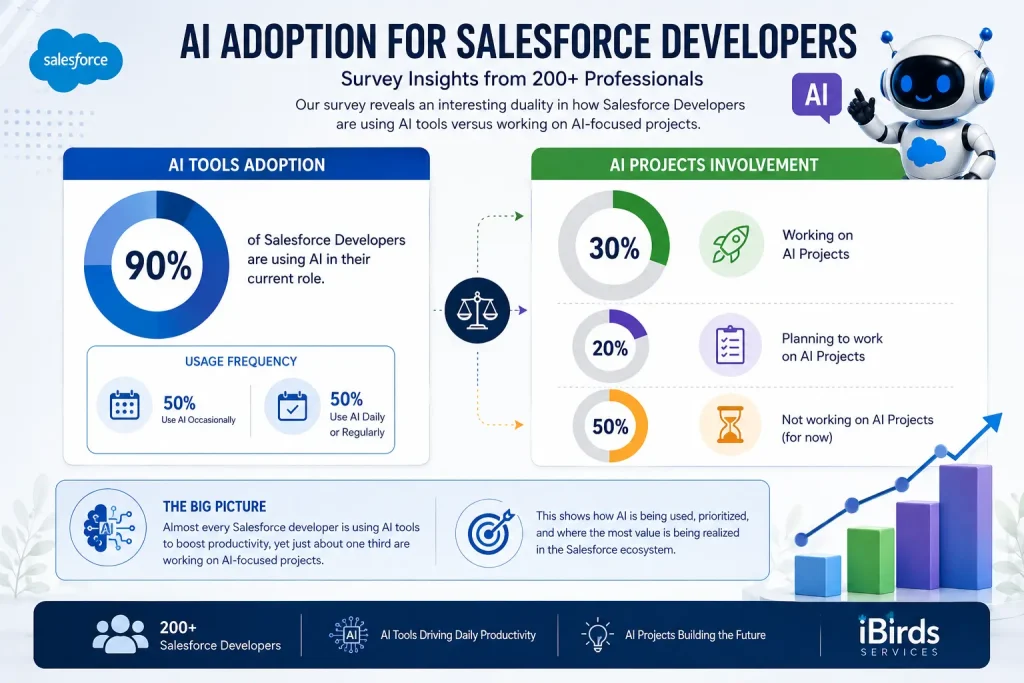
Industry research across the Salesforce ecosystem revealed two important findings. The first shows that AI has become a regular part of daily work for Salesforce developers. Nearly 90% of surveyed developers reported using AI in their current role, with usage almost evenly divided between occasional use and regular daily adoption.
The survey also revealed an interesting trend regarding project involvement. Although AI tools are widely used by developers, only around 30% reported working directly on AI-focused Salesforce projects, while another 20% indicated plans to participate in AI implementations in the future.
This creates an interesting contrast. Most Salesforce developers rely on AI to improve their daily productivity, yet only a smaller percentage are building AI-powered business solutions. These findings highlight how AI Adoption for Salesforce Developers is progressing, where organizations are prioritizing AI investments, and how businesses are creating value through Salesforce AI initiatives.
What Are AI Projects?
To understand this difference, it is important to define what AI projects actually involve. Many Salesforce developers use AI-powered tools such as Agentforce, GitHub Copilot, Claude Code, Cursor, and ChatGPT to support software development. These tools assist with coding, documentation, troubleshooting, and other development tasks while developers remain responsible for reviewing, refining, and approving every outcome.
Using AI in this way reduces the time spent on repetitive development activities and allows Salesforce professionals to focus on architecture, business logic, integrations, and other strategic responsibilities that require technical expertise.
AI projects, however, involve much more than using AI assistants. These projects focus on designing and implementing AI capabilities that solve real business challenges. Instead of using existing AI products, developers build solutions that enable organizations to integrate artificial intelligence into their Salesforce environment.
Typical AI projects include implementing Agentforce capabilities inside Salesforce, building custom Agent Actions with Apex, integrating Salesforce with external AI platforms, or connecting Salesforce data with third-party large language model (LLM) solutions. Businesses adopting these advanced AI solutions often work with Salesforce Integration Services to connect Salesforce securely with enterprise applications and AI platforms while maintaining reliable data flow across systems.
AI Tools Are Only One Part of AI Adoption
Most Salesforce developers are now familiar with AI tools that support everyday work in both professional and personal environments. These tools simplify repetitive tasks, improve efficiency, and help developers spend more time on activities that require technical expertise and business knowledge.
However, AI extends far beyond modern generative AI tools. Salesforce has been delivering AI-powered capabilities for years through features such as Salesforce Einstein, including Predictive Lead Scoring in Sales Cloud, Recommended Case Classification in Service Cloud, and intelligent recommendations across Experience Cloud. While these capabilities differ from today’s generative AI solutions, they remain valuable examples of artificial intelligence supporting business processes.
The arrival of ChatGPT significantly increased interest in generative AI by demonstrating how Large Language Models (LLMs) can generate content, answer questions, and assist with complex tasks. Since then, many organizations have developed enterprise AI solutions powered by LLM technology. For Salesforce professionals, Agentforce represents one of the most important advancements, helping organizations automate business processes and generate intelligent actions based on Salesforce data.
Artificial intelligence has advanced rapidly over the past few years, particularly since 2022, but AI itself is not a new technology. Generative AI has become more widely adopted, yet it represents only one category within the broader field of artificial intelligence. Businesses investing in Salesforce AI Consulting Services can evaluate both traditional AI capabilities and modern generative AI solutions to determine the right approach for their Salesforce environment.
The Impact on Productivity
One of the primary goals of AI Adoption for Salesforce Developers is improving productivity. Whether developers are using AI-powered development tools or building AI-enabled Salesforce solutions, the objective remains the same: increase business output while reducing repetitive manual effort.
Developers working with tools such as Agentforce, Claude Code, or GitHub Copilot can delegate repetitive coding, documentation, and administrative tasks to AI assistants. This allows them to focus on solution architecture, business requirements, integrations, and complex Salesforce development activities that require human expertise. Organizations implementing Salesforce Managed Services can also improve long-term productivity by combining AI-driven automation with continuous Salesforce optimization and support.
Why AI Projects May Be Growing More Slowly
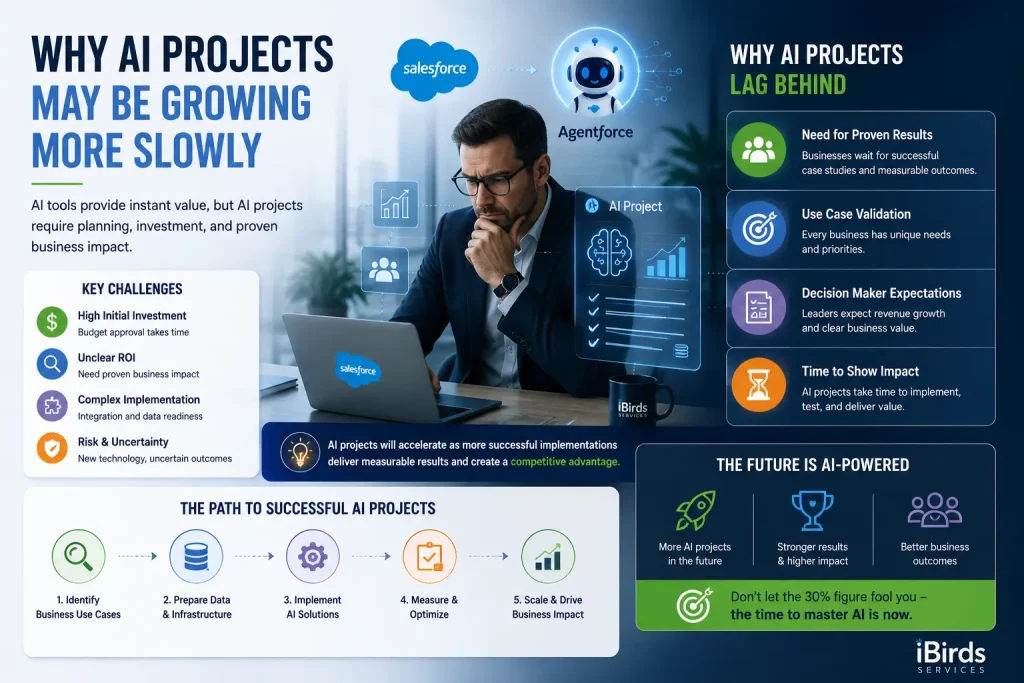
Many discussions focus on why enterprise AI adoption appears slower than expected. One important reason is that Salesforce developers have been exposed to LLM-based AI much earlier than most business users.
Although ChatGPT became widely available in late 2022, the underlying GPT (Generative Pre-trained Transformer) technology existed several years earlier through API access. Developers were already experimenting with AI models before conversational AI became accessible through user-friendly interfaces. Similarly, GitHub Copilot introduced AI-assisted development before many businesses started adopting generative AI across their operations.
Another important factor is the difference between using AI tools and investing in AI projects. Developers can quickly experience the benefits of existing AI products because they are already available, tested, and supported by successful real-world examples. Building custom AI solutions requires organizations to identify business use cases, evaluate implementation costs, and demonstrate measurable business value before making significant investments.
Business leaders often expect clear evidence that AI projects will improve operational efficiency, customer experience, or revenue growth. Without measurable results, many organizations remain cautious about large-scale AI implementations. As more successful Agentforce deployments demonstrate practical business outcomes, confidence in enterprise AI projects is expected to increase. Businesses working with Agentforce Implementation Services can reduce implementation risks while building AI solutions that align with measurable business objectives.
Summary
The growing use of AI among Salesforce developers does not conflict with the smaller percentage of developers working directly on AI-focused projects. Instead, it reflects how organizations are adopting AI in different ways. Developers are already gaining value from AI-powered tools across many Salesforce projects, while enterprise AI implementations continue to expand as businesses identify practical use cases and measurable outcomes.
As AI Adoption for Salesforce Developers continues to grow, organizations that invest in reliable Salesforce data, practical AI strategies, and well-planned implementations will be better positioned to benefit from future advancements in Agentforce, generative AI, and intelligent Salesforce automation. Businesses partnering with Salesforce Consulting Services can accelerate this journey by implementing AI solutions that support long-term business growth and operational efficiency.
iBirds Software Services CRM Firm
FAQs
1. What is AI Adoption for Salesforce Developers?
AI Adoption for Salesforce Developers refers to using artificial intelligence tools and technologies, such as Agentforce and generative AI, to improve Salesforce development, automate repetitive tasks, and build intelligent business solutions.
2. Why are Salesforce developers adopting AI tools?
Salesforce developers use AI tools to automate routine development tasks, improve coding efficiency, generate documentation, troubleshoot issues, and spend more time on complex business solutions.
3. What is the difference between AI tools and AI projects?
AI tools help developers perform daily tasks more efficiently, while AI projects involve designing, building, and implementing AI-powered solutions such as Agentforce, AI integrations, and custom AI applications within Salesforce.
4. How does Agentforce support Salesforce developers?
Agentforce helps Salesforce developers automate workflows, create intelligent Agent Actions, improve productivity, and build AI-powered business processes using trusted Salesforce data.
5. Why are AI projects growing more slowly than AI tool adoption?
Many organizations require proven business outcomes, clear ROI, and well-defined use cases before investing in AI projects. While AI tools provide immediate productivity benefits, custom AI implementations require planning, integration, and business validation.
6. How does AI improve Salesforce developer productivity?
AI reduces manual coding, documentation, testing, debugging, and repetitive development tasks, allowing developers to focus on architecture, integrations, business logic, and customer-focused solutions.
7. Which AI tools are commonly used by Salesforce developers?
Popular AI tools include Agentforce, GitHub Copilot, Claude Code, Cursor, ChatGPT, and other Large Language Model (LLM)-powered development assistants that support Salesforce development workflows.
8. How can iBirds Services help businesses adopt AI in Salesforce?
iBirds Services helps businesses implement Agentforce, integrate AI with Salesforce, build custom AI solutions, optimize Salesforce data, and create AI-driven workflows that improve business efficiency and productivity.