

How to Build a Salesforce Campaign Influence Model That Actually Works
Salesforce Campaign Influence is designed to help marketers understand how their campaigns contribute to revenue. However, in real-world scenarios, many businesses struggle because their reports do not reflect the true impact of their marketing efforts. The main reason behind this issue is that Salesforce’s standard influence models are quite rigid and limited, making it difficult to accurately represent multi-touch customer journeys.
When your reporting does not align with your actual campaign performance, it directly affects your decision-making process. That is why it becomes important to build a Campaign Influence Model that is tailored to your business needs and provides meaningful insights.
Where is Your Salesforce Data Holding You Back?
Many organizations rely heavily on Salesforce’s default models, but these models often lack flexibility and control. As a result, the data shown in reports does not match the real performance of campaigns. This creates confusion between marketing and sales teams, as both rely on different interpretations of success.
If your data is not working correctly, it can negatively impact your growth, ROI tracking, and overall strategy. Identifying these gaps is the first step toward improving your campaign influence model.
Standard Campaign Influence Models and Their Limits
Salesforce offers several standard models that provide a basic foundation, but they fall short when it comes to handling complex customer journeys. The Primary Campaign Source model assigns 100% credit to a single campaign, which completely ignores other important touchpoints. Similarly, First Touch and Last Touch models focus only on one part of the journey, either the beginning or the end, leaving out the full picture.
The Even Distribution model attempts to solve this by splitting credit equally across all campaigns. While this may seem fair, it is not realistic because not all campaigns have the same level of impact. Treating every campaign equally can lead to misleading insights and poor decision-making.
Why Standard Models Are Not Enough
Standard models often misrepresent campaign performance by undervaluing high-impact activities like events and overvaluing high-volume activities such as emails. This imbalance leads to inaccurate ROI tracking and inefficient budget allocation.
As a result, marketing teams may invest in the wrong channels, while sales teams lose confidence in marketing data. This misalignment can slow down overall business growth and reduce the effectiveness of your strategy.
Salesforce Example Code: Why It Falls Short
Salesforce does provide sample code for building custom influence models, but it comes with several limitations. The code is not well-documented, making it difficult to understand and implement. It is also not production-ready, which means developers need to spend additional time modifying and testing it.
Another major issue is that the sample implementation depends on existing models, which limits your control over calculations. Debugging becomes complicated because the execution runs under a special system user, and there are no clear testing examples provided. All of these challenges make it harder to build a reliable and scalable solution.
How to Build a Better Campaign Influence Model
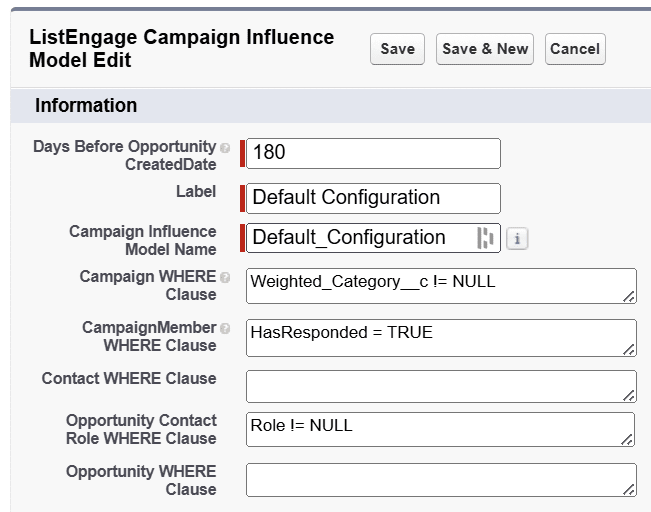
To overcome these limitations, you need to adopt a custom approach that reflects your actual marketing strategy. The first step is to define campaign categories based on how your business operates. Grouping campaigns into meaningful categories helps differentiate between high-value and low-value activities.
Once the categories are defined, the next step is to assign weights to each category based on its impact. For example, events may carry a higher weight compared to newsletters because they contribute more significantly to conversions. This weighted approach ensures that your model reflects real-world influence more accurately.
After setting up categories and weights, you need to build custom logic that calculates influence using data from contacts, campaign members, and opportunities. This logic should consider engagement levels, timeframes, and campaign attributes to create a realistic attribution model.
Finally, it is important to validate and refine your model. Initial results may not be perfect, so continuous testing and adjustments are necessary to improve accuracy over time.
Benefits of a Custom Campaign Influence Model
Implementing a custom campaign influence model brings several advantages. One of the biggest benefits is improved reporting accuracy, as your dashboards will now reflect the true impact of your campaigns. This allows marketing teams to better understand which strategies are driving results.
In addition, budget allocation becomes more effective because you can invest in campaigns that actually contribute to revenue. Sales teams also gain more trust in marketing data, which improves collaboration and alignment across departments.
Alternative Options If You Don’t Want to Build
Not every organization has the resources or time to build a custom model from scratch. In such cases, there are alternative options available. You can enhance your existing reporting by customizing Salesforce dashboards and reports, which can provide better insights without requiring complex development.
For faster implementation, many businesses choose paid attribution tools that offer ready-made solutions. These tools simplify the process and reduce development effort, although they may come with additional costs and limited flexibility.
Build vs Buy: What Should You Choose?
The decision between building and buying depends on your business priorities and available resources. If you have the technical expertise and want complete control over your model, building a custom solution is the better choice. On the other hand, if you need quick results and prefer a low-maintenance option, purchasing a ready-made tool can be more practical.
Both approaches can be effective, as long as they align with your business goals and long-term strategy.
Best Practices and Recommendations
When creating a campaign influence model, it is important to keep the design simple and easy to manage. Starting with fewer categories and clearly defined weights makes the model more understandable and scalable. Aligning your team at the beginning is also crucial, as it ensures everyone trusts the data and understands how it is calculated.
Regularly reviewing and updating your model is necessary to keep it aligned with changing marketing strategies. Transparency in your calculations will also help build trust among stakeholders and improve adoption across teams.
Internal Linking (iBirds Digital Services)
If you want to improve your Salesforce performance and marketing results, iBirds Digital offers expert solutions such as Salesforce Consulting Services, Marketing Automation Services, and Digital Marketing Services. These services can help you optimize your campaigns, improve reporting accuracy, and drive better business outcomes.
Final Thoughts
Campaign Influence plays a critical role in understanding the effectiveness of your marketing efforts. While standard models provide a starting point, they are often not sufficient for long-term success. A customized approach allows you to capture the true impact of your campaigns and make smarter business decisions.
Whether you choose to build your own model or use an external tool, the ultimate goal is to ensure that your data accurately represents your marketing performance and supports your growth strategy – SEO Services
FAQs
Q1. What is Salesforce Campaign Influence?
Salesforce Campaign Influence is a feature that helps businesses track how different marketing campaigns contribute to sales opportunities. It connects campaign interactions with leads and opportunities, allowing marketers to understand which campaigns are actually driving conversions and revenue.
Q2. Why are standard Campaign Influence models not accurate?
Standard models are often not accurate because they simplify the customer journey and assign credit to only one or a few touchpoints. In reality, customers interact with multiple campaigns before making a decision, and these models fail to represent that complete journey properly.
Q3. What is a weighted campaign influence model?
A weighted campaign influence model is a custom approach where different campaigns are assigned different values based on their importance and impact. This ensures that high-value campaigns like events get more credit compared to lower-impact activities like emails or newsletters.
Q4. Should I build or buy a campaign attribution tool?
The choice between building and buying depends on your business needs and resources. If you want full control and customization, building your own model is a good option. However, if you need faster implementation and less maintenance, using a ready-made attribution tool can be more practical.Q5. How often should a campaign influence model be updated?
A campaign influence model should be reviewed and updated regularly to match your current marketing strategy. As your campaigns and customer behavior change over time, updating the model ensures that your reporting remains accurate and relevant.