

The Salesforce Quote-to-Cash Implementation process plays a central role in helping businesses convert sales opportunities into revenue through a structured workflow. With Salesforce CPQ, Billing, Revenue Cloud, and AI-powered pricing capabilities becoming more advanced, many organizations still face implementation challenges. In most cases, the issue is not the technology itself but how business processes are planned, configured, and connected. As subscription-based pricing, complex product catalogs, and cross-functional operations continue to grow, a well-designed Quote-to-Cash strategy becomes essential for long-term success.
Across many Salesforce implementation projects, similar patterns continue to appear. Teams often automate existing workflows without simplifying them first, involve Finance or Legal teams too late, or underestimate the impact of contract changes and entitlement management. These decisions can result in difficult-to-maintain processes, low user adoption, and unnecessary implementation costs. Organizations planning scalable Salesforce Consulting Services often begin by aligning business goals and process requirements before configuring the platform.
Is Your Salesforce Quote-to-Cash Process Limiting Business Growth?
This article explains the most common reasons why a Salesforce Quote-to-Cash Implementation struggles and outlines practical ways to build a scalable, reliable, and well-connected process that supports Sales, Finance, and Fulfillment teams.
Common Salesforce Quote-to-Cash Challenges
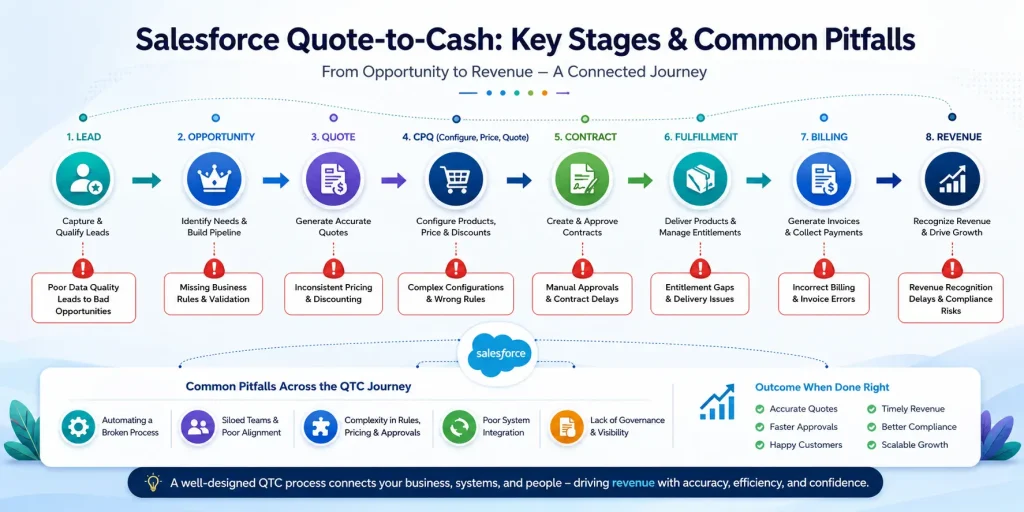
Many Quote-to-Cash projects face difficulties because of process design rather than platform capabilities. Poor planning, disconnected teams, and excessive dependence on automation often create more complexity than efficiency. In many cases, improving the process is more valuable than adding additional automation.
Pitfall 1: Automating an Inefficient Process
Many organizations begin their Salesforce Quote-to-Cash Implementation with the goal of increasing speed through automation. However, automating an inefficient workflow only transfers existing problems into Salesforce.
For example, one organization managed several approval processes using different spreadsheets. Simply automating those approval paths would have carried every inconsistency into the new system. Instead of improving efficiency, it would have created ongoing maintenance challenges, inconsistent business rules, and lower user confidence.
A successful implementation begins by simplifying business processes before automation starts. Strong Salesforce Quote-to-Cash projects focus on business alignment first and system configuration second.
Pitfall 2: Ignoring Customer and Product Complexity
Many businesses attempt to manage every customer, product, and pricing scenario with a single pricing model, discount policy, or approval process. Although this may appear manageable initially, it becomes increasingly difficult as products, regions, and customer requirements expand.
When business logic does not reflect actual customer behavior or product variations, pricing rules become difficult to maintain, product bundles fail to support new offerings, and sales teams spend more time handling exceptions than closing opportunities.
Scalable Salesforce Quote-to-Cash implementations rely on metadata-driven configuration and flexible business rules that grow alongside changing business requirements.
Read More: Architect Decision Guides: Design Scalable, Future-Proof Solutions
Pitfall 3: Delaying Contract and Entitlement Planning
Many implementations focus heavily on quoting and billing while postponing contract and entitlement management until a later phase. Unfortunately, adding these capabilities after deployment becomes significantly more difficult.
It is common to see quotes and invoices working correctly while customers still experience delays accessing purchased products or services. This creates additional manual work for fulfillment teams, increases financial adjustments, and affects customer satisfaction.
Designing entitlement management together with quoting and billing creates a more reliable Quote-to-Cash process where product delivery remains aligned with customer purchases.
Pitfall 4: Underestimating Amendments and Renewals
Contract amendments and renewals frequently expose weaknesses within a Salesforce Quote-to-Cash Implementation. Mid-term contract updates can create incorrect prorated charges, manual billing corrections, and unnecessary administrative work.
Without clearly defined rules for contract amendments, renewals, and retroactive pricing adjustments, every contract modification becomes increasingly difficult to manage.
Organizations that validate amendment scenarios before deployment are better prepared to maintain accurate pricing and billing as customer agreements continue to change.
Pitfall 5: Involving Finance Too Late
Finance teams are sometimes included only after pricing structures, approval processes, and billing workflows have already been finalized. Correcting financial compliance issues at that stage often requires significant redesign.
Early collaboration allows Finance teams to validate tax rules, revenue recognition requirements, and compliance standards before implementation decisions become permanent. Shared ownership across departments reduces future rework while improving overall business confidence.
Pitfall 6: Automating Business Policies Instead of Managing Them
Automation delivers the greatest value when applied to consistent, repeatable business processes. However, some organizations attempt to automate every rare exception, creating highly complicated workflows that become difficult to support.
In many situations, a clearly documented business policy or simple user guidance solves the problem more effectively than additional automation. Successful Salesforce Quote-to-Cash implementations automate standard business patterns while keeping exceptional situations straightforward and manageable.
Other Salesforce Quote-to-Cash Challenges You Shouldn’t Ignore
Even a well-planned Salesforce Quote-to-Cash Implementation can encounter issues that are easy to overlook during project planning but become significant after deployment. Problems such as mismatched quote and fulfillment processes, inconsistent document templates, or business rules that fail to support regional operations can gradually reduce user confidence and operational efficiency.
The Gap Between Solution Design and Business Execution
A Salesforce Quote-to-Cash process may perform well during testing but still create operational challenges once customer orders move into fulfillment. Properly configured quotes can become difficult to process when product hierarchies, Stock Keeping Units (SKUs), or ERP records are not aligned with Salesforce. Even small differences in naming conventions can create confusion across departments.
Document management creates similar challenges. A single quote template often expands into multiple regional versions with different branding, pricing terms, or legal clauses. This increases complexity for Finance and Legal teams responsible for maintaining document consistency. These problems are usually caused by process design rather than technology. Organizations implementing Salesforce Integration Services can reduce these risks by establishing consistent data models, standardized documentation, and early collaboration between Sales, Fulfillment, and IT teams before user acceptance testing begins.
When Business Controls Become Too Complex
Approval workflows and pricing rules are created to strengthen governance, but they can eventually slow business operations if they become overly complicated. A simple approval hierarchy can gradually expand into numerous approval paths, delaying sales cycles and reducing confidence in the Quote-to-Cash process.
Pricing logic often follows the same pattern. As new exceptions continue to be added, the overall configuration becomes increasingly difficult to understand and maintain. A more sustainable approach focuses on validating business data early, simplifying approval structures, and using metadata-driven pricing rules. The objective is to build a flexible framework that can support future business growth without creating unnecessary complexity.
When Business Growth Exceeds the Original Design
Business expansion quickly reveals limitations within a Salesforce Quote-to-Cash Implementation. Supporting multiple currencies, tax regulations, pricing models, and billing schedules requires an architecture designed for long-term scalability. Systems originally configured for one region often struggle when organizations expand into new markets.
Instead of attempting to predict every future business scenario, successful implementations are built with flexibility from the beginning. Metadata-based pricing, localization-aware business rules, and regional compliance models allow organizations to scale while maintaining operational consistency. Real-world quote-to-invoice testing within sandbox environments also helps identify potential issues before deployment.
Ultimately, long-term success depends less on handling complexity and more on designing systems that can adapt as business requirements continue to evolve.
Read More: Is Salesforce CPQ Really Dying?
Real-Time Execution Challenges That Impact Daily Operations
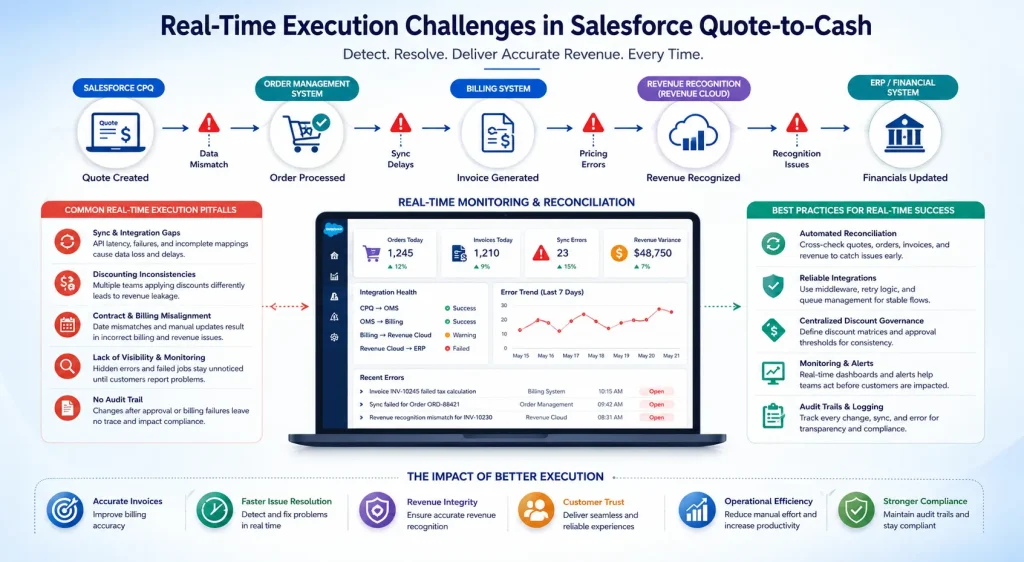
Even after successful deployment, a Salesforce Quote-to-Cash Implementation can experience execution challenges that directly affect invoicing accuracy, revenue recognition, and customer satisfaction. These issues may not be immediately visible but can gradually reduce confidence in Salesforce CPQ, Billing, and Revenue Cloud processes.
Small synchronization issues often become the starting point. A quote may lose a discount, pricing adjustment, or product line while moving between connected systems because of delayed synchronization or incomplete field mapping. These discrepancies frequently result in incorrect invoices and unnecessary manual corrections. Automated reconciliation between quotes, orders, and invoices helps identify these problems before customers are affected.
Minor contract updates can also create operational difficulties. Changes to contract dates or pricing terms may require manual modifications if amendment logic has not been properly designed. Keeping contract information, billing schedules, and validation rules synchronized across systems helps maintain accurate revenue recognition and reduces administrative effort.
As transaction volumes increase, API latency and integration delays become additional concerns. Reliable integrations supported by queue management, retry mechanisms, and proper monitoring allow business processes to continue without interrupting day-to-day operations.
Discount management presents another challenge. When Sales, Partner Channels, and Customer Success teams apply discounts differently, pricing consistency becomes difficult to maintain. Clearly defined approval thresholds and centralized pricing policies reduce revenue leakage while supporting compliance.
Many operational issues remain unnoticed because organizations lack monitoring and audit capabilities. Failed billing processes, post-approval quote changes, or hidden synchronization errors may only become visible after customer complaints. Audit trails, detailed logging, and version tracking provide greater transparency while improving system reliability.
Successful Quote-to-Cash operations are not built by avoiding every issue but by identifying, correcting, and preventing problems before they affect customers. Accurate execution ultimately strengthens both operational performance and customer confidence.
When eCommerce and Salesforce Quote-to-Cash Work Together
Organizations integrating eCommerce platforms with a Salesforce Quote-to-Cash Implementation often complete most technical work successfully but encounter unexpected challenges during final execution. What appears to be a straightforward integration between an online storefront and Salesforce Billing can become increasingly complex as real customer transactions begin flowing through connected systems.
Initially, products, customer records, orders, and payments may appear synchronized. However, real business activity often reveals inconsistencies. Product bundles created within an eCommerce platform may not match Salesforce CPQ configurations. Discounts applied during checkout may not transfer correctly into billing processes, leading to manual financial adjustments. Tax calculations performed by different systems can produce conflicting invoice values. Customer information may also exist in separate databases without proper synchronization, making it difficult to maintain a complete customer view.
These small inconsistencies gradually create larger operational problems, including inaccurate invoices, delayed order fulfillment, and additional support requests. From the customer’s perspective, the purchasing experience becomes fragmented.
Organizations reduce these challenges by standardizing product catalogs across connected systems, transferring pricing, discount, and tax information through structured data, maintaining a unified customer record, and tracking every order throughout its lifecycle. When these practices are established, the final stage of Quote-to-Cash becomes a reliable connection between the customer experience and the Salesforce ecosystem.
Stakeholder Challenges and Salesforce Quote-to-Cash Solutions
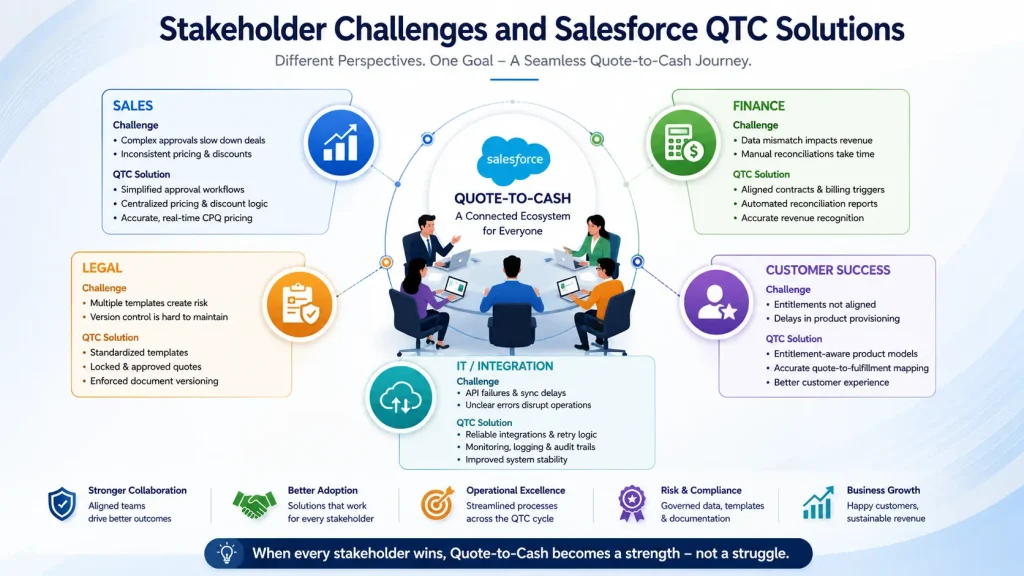
One of the most important factors in a successful Salesforce Quote-to-Cash Implementation is understanding that every department measures success differently. The challenges faced by Sales are rarely the same as those experienced by Finance, Legal, Customer Success, or IT. Addressing these business priorities early not only improves user adoption but also creates stronger collaboration across teams working within the same Quote-to-Cash process.
Sales Teams Need Faster and More Predictable Processes
Sales teams are primarily focused on closing opportunities quickly. Complicated approval workflows and inconsistent pricing rules often slow deal progression and reduce confidence in the system. When sales representatives cannot rely on CPQ pricing or promotional discounts, manual verification becomes part of the sales process.
Simplifying approval workflows, centralizing pricing rules, and maintaining consistent discount policies help sales teams work more efficiently while improving overall confidence in the Quote-to-Cash process.
Finance Prioritizes Accuracy Over Speed
For Finance teams, accurate billing and revenue recognition are far more important than processing speed. Problems arise when approved quotes change unexpectedly or contract information is not properly synchronized with billing events. These inconsistencies make financial reporting difficult and increase reconciliation efforts.
Organizations using Salesforce Support Services can strengthen financial operations by aligning contract records with billing processes, validating financial data throughout the implementation, and automating reconciliation reports that improve reporting accuracy.
Legal Requires Consistent Documentation
Legal teams depend on standardized documents and controlled version management. Multiple quote templates, inconsistent contract language, and unmanaged document revisions increase compliance risks and create uncertainty during customer negotiations.
Maintaining approved templates, controlling document versions, and establishing governance around contractual documents helps ensure consistency across every sales transaction.
Customer Success Depends on Accurate Product Delivery
Customer Success teams experience challenges when sold products are not provisioned correctly or become available before billing has been completed. Misalignment between product delivery and customer entitlements creates confusion and affects customer satisfaction.
Well-designed entitlement models and properly mapped quote-to-fulfillment processes ensure customers receive the correct products and services at the appropriate stage of the sales cycle.
IT Teams Focus on Reliable Integrations
IT and integration teams are responsible for maintaining stable system performance. API failures, synchronization delays, and unclear system errors can interrupt daily business operations if integrations are not designed for reliability.
Strong integration architecture, retry mechanisms, monitoring tools, and audit logging help technical teams quickly identify issues while maintaining dependable communication between Salesforce and connected business applications.
Every department defines implementation success differently. Sales measures efficiency, Finance values compliance, Legal focuses on governance, Customer Success prioritizes service delivery, and IT emphasizes system stability. A Salesforce Quote-to-Cash Implementation that addresses only one department’s priorities is unlikely to deliver long-term business value.
The most successful projects treat Quote-to-Cash as an enterprise-wide business initiative rather than an individual departmental implementation. Bringing Sales, Finance, Legal, Customer Success, and IT together during project discovery creates alignment that supports every phase of implementation.
Salesforce Quick Start Services
Consultant Blueprint for a Successful Salesforce Quote-to-Cash Implementation
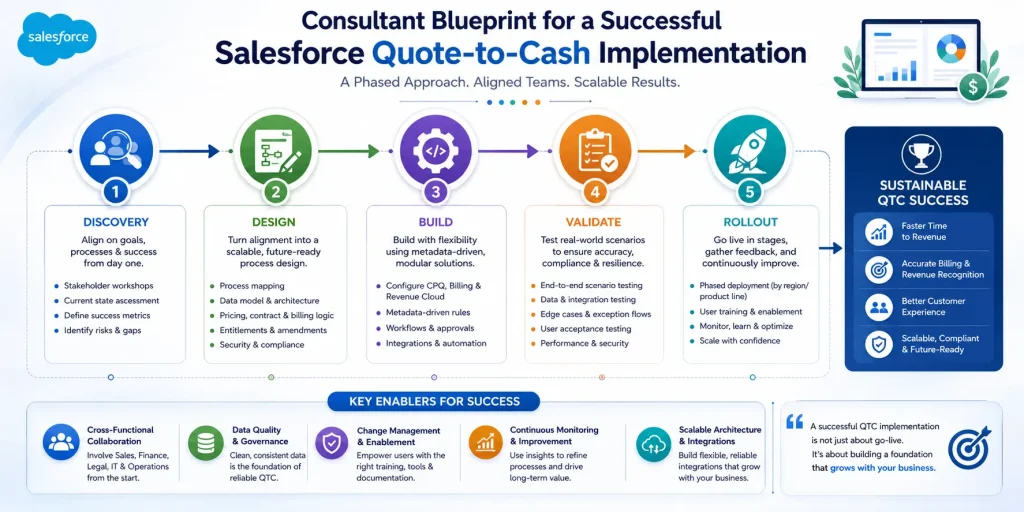
Successful Salesforce Quote-to-Cash Implementations rarely attempt to complete every requirement at once. Instead, they follow a structured implementation approach that balances business alignment, phased delivery, and continuous improvement.
A practical implementation roadmap includes:
- Discovery: Business stakeholders from Sales, Finance, Legal, and Fulfillment should define common objectives before implementation begins.
- Design: Separate pricing, contracts, billing, amendments, and entitlement management into clearly structured business processes.
- Build: Configure scalable, metadata-driven solutions instead of hard-coded customizations that become difficult to maintain.
- Validate: Test real business scenarios instead of only ideal workflows to identify operational issues before deployment.
- Rollout: Deploy gradually by product line, business unit, or region to improve user adoption and reduce implementation risk.
Following these phases creates more than an implementation methodology—it establishes a long-term operating model. Organizations that keep Sales, Finance, and Operations aligned throughout every phase reduce implementation risk while creating a stronger foundation for future business growth.
A phased deployment also increases adoption because business users become involved throughout the implementation instead of only after deployment. Continuous collaboration helps organizations build a Salesforce Quote-to-Cash Implementation that remains scalable as business requirements continue to evolve.
Designing Salesforce Quote-to-Cash for Long-Term Success
The true success of a Salesforce Quote-to-Cash project is measured months after deployment. As organizations introduce new products, pricing models, markets, and revenue strategies, systems without proper governance often become increasingly difficult to maintain.
A well-managed product catalog forms the foundation of a scalable implementation. Product information, pricing structures, tax classifications, and SKU definitions should be managed through centralized governance instead of disconnected spreadsheets.
Version management is equally important. Without controlled tracking of pricing rules, quote templates, and configuration changes, Finance teams struggle to verify billing accuracy. Proper version control and documented change management improve transparency while supporting compliance.
Integration architecture also plays an important role in long-term scalability. Instead of relying on tightly connected point-to-point integrations, organizations implementing Salesforce Lightning Migration Services often benefit from flexible integration frameworks that simplify future enhancements without increasing technical complexity.
System visibility should also be built into every implementation. Audit logs, monitoring tools, metadata tracking, and detailed reporting allow organizations to understand how pricing decisions, approvals, and billing activities occur throughout the Quote-to-Cash lifecycle.
Technology alone cannot guarantee long-term success. Ongoing user enablement, implementation documentation, governance standards, and regular solution reviews help organizations maintain system quality while encouraging collaboration across business teams.
Ultimately, a successful Salesforce Quote-to-Cash Implementation combines people, business processes, and technology into a framework that continues supporting organizational growth over time.
Read More: 10 Salesforce CPQ Features You Should Know About
Final Thoughts
Most Quote-to-Cash implementation challenges originate from planning decisions rather than Salesforce capabilities. Automating inefficient processes, introducing unnecessary complexity, or delaying collaboration with Finance, Legal, and Fulfillment teams often creates avoidable operational issues.
Organizations consistently achieve stronger results when they:
- Design amendment, renewal, and entitlement processes from the beginning.
- Keep business workflows simple instead of automating uncommon scenarios.
- Involve Sales, Finance, Legal, and Fulfillment throughout implementation.
- Maintain governance over product catalogs, pricing rules, templates, and configuration changes.
Salesforce Healthcare Services
Long-term success extends well beyond deployment. As organizations introduce new products, expand into additional markets, and adopt evolving revenue models, scalable governance and continuous improvement become increasingly valuable. Teams that prioritize documentation, enablement, and business alignment build Salesforce environments that continue delivering value long after implementation.
Salesforce Revenue Cloud continues to evolve with capabilities such as subscription management, consumption-based billing, and AI-assisted pricing strategies. Organizations that establish strong Quote-to-Cash fundamentals now will be better prepared to support future business requirements while maintaining operational consistency.
A successful Salesforce Quote-to-Cash Implementation is more than a technology project. It is a business strategy that aligns people, processes, and data to create sustainable growth across the organization.
FAQs
1. What is a Salesforce Quote-to-Cash implementation?
A Salesforce Quote-to-Cash implementation is the process of connecting CPQ, contracts, billing, invoicing, and revenue management into one streamlined workflow. It helps organizations manage the complete sales lifecycle with greater accuracy and efficiency.
2. Why do Salesforce Quote-to-Cash implementations fail?
Most Salesforce Quote-to-Cash implementations fail because of poor process design, disconnected business teams, inconsistent pricing rules, weak integrations, and limited planning for contracts, renewals, and entitlements.
3. What are the biggest challenges in Salesforce Quote-to-Cash?
Some of the most common challenges include complex approval workflows, pricing inconsistencies, billing errors, contract amendments, integration failures, revenue recognition issues, and manual business processes.
4. How can businesses improve their Salesforce Quote-to-Cash process?
Businesses can improve their Salesforce Quote-to-Cash process by simplifying workflows, standardizing pricing rules, improving data quality, involving Finance and Legal teams early, and building scalable integrations across business systems.
5. Why is Salesforce CPQ important in a Quote-to-Cash implementation?
Salesforce CPQ helps sales teams generate accurate quotes, apply consistent pricing rules, manage product configurations, and reduce manual errors, making the Quote-to-Cash process faster and more reliable.
6. How do integrations affect Salesforce Quote-to-Cash performance?
Reliable integrations keep Salesforce CPQ, ERP, Billing, Revenue Cloud, and other business applications synchronized. This reduces billing errors, improves data accuracy, and supports faster order processing.
7. What should organizations consider before starting a Salesforce Quote-to-Cash implementation?
Organizations should review existing business processes, define pricing and approval policies, involve all key stakeholders, prepare integration requirements, and create a scalable implementation roadmap before beginning the project.
8. How does Salesforce Quote-to-Cash support business growth?
A well-designed Salesforce Quote-to-Cash implementation improves operational efficiency, shortens sales cycles, strengthens revenue management, enhances customer experience, and provides a scalable foundation for future business growth.