

AI Adoption Among Salesforce Developers: Key Trends From Recent Survey Results
Artificial intelligence has become an important part of the Salesforce development process, changing how developers complete projects and manage everyday tasks. Recent trends show that while AI tools are becoming common across the Salesforce ecosystem, the way developers use them is not always reflected in the number of AI-powered implementations they build. This difference provides useful insight into the current stage of Salesforce AI adoption and how organizations are approaching AI-driven development.
In this article, we’ll examine the latest trends in AI adoption among Salesforce developers, understand how AI is being used in real-world Salesforce projects, and look at why the growth of AI tools is progressing faster than dedicated AI implementations.
Salesforce Consulting Services
The Metrics
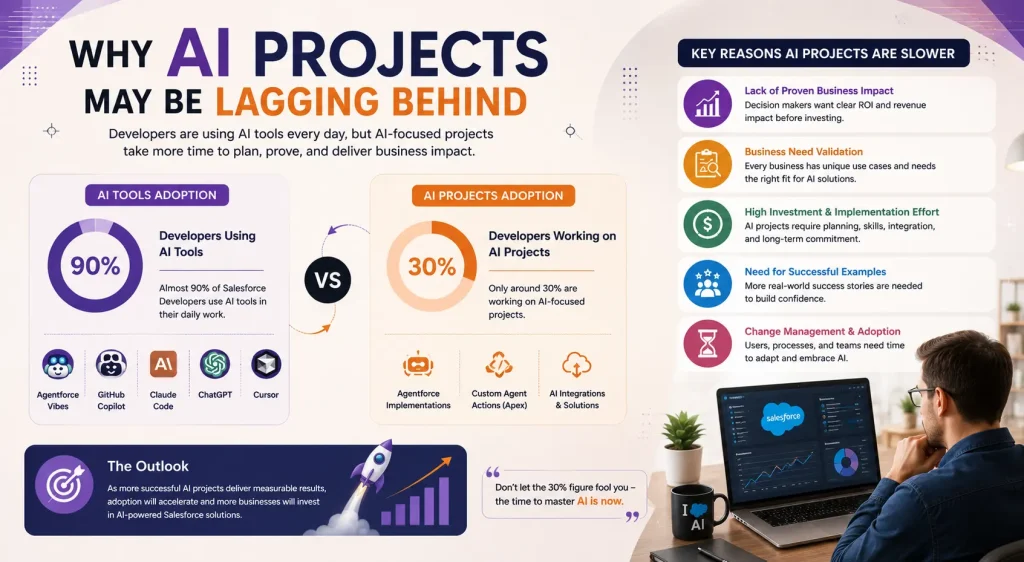
Recent findings from a Salesforce developer survey highlight two notable trends across the ecosystem. The first is the widespread use of AI in day-to-day development work. Nearly 90% of Salesforce developers reported using AI tools in their current role. The usage is almost evenly divided between developers who rely on AI regularly and those who use it whenever specific tasks require additional support.
The survey also revealed a different trend regarding project work. Although AI tools have become a regular part of the development workflow, only about 30% of developers said they are actively working on Salesforce AI projects. Another group of respondents indicated they expect to participate in AI-focused implementations in the future as business priorities continue to evolve.
This gap between AI tool usage and AI project development highlights an important reality. Salesforce professionals are already using AI to improve coding efficiency, automate repetitive work, and support decision-making, but organizations are adopting AI-powered Salesforce solutions more gradually. It suggests that businesses recognize the productivity benefits of AI while taking a measured approach to implementing larger AI initiatives across their Salesforce environments.
What Are Salesforce AI Projects?
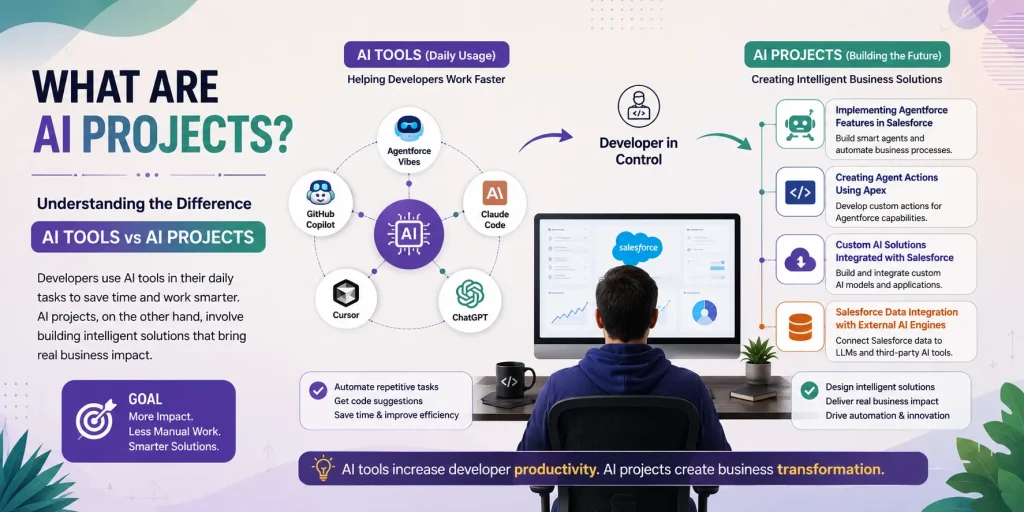
To understand the difference between AI adoption and AI-focused development, it’s important to define what qualifies as an AI project in Salesforce. Many Salesforce developers use AI tools as part of their daily workflow, but that doesn’t necessarily mean they are building AI-powered solutions for businesses.
Developers commonly rely on tools such as Agentforce, GitHub Copilot, Claude Code, Cursor, and ChatGPT to improve productivity during development. These tools assist with writing code, generating formulas, reviewing Apex classes, creating documentation, and solving technical challenges. However, developers remain responsible for every decision, using AI as a supporting technology rather than replacing their expertise.
As a result, repetitive development tasks can be completed more efficiently, giving developers additional time to focus on business requirements, solution architecture, system optimization, and complex Salesforce implementations that require human judgment.
Salesforce Development Services
AI projects, however, involve much more than using AI-powered coding assistants. These projects focus on designing and implementing intelligent business solutions where AI capabilities become part of the Salesforce platform itself. Instead of simply using an existing AI tool, developers build custom solutions that enable organizations to automate processes, improve customer interactions, and support data-driven decision-making.
Examples of Salesforce AI implementation projects include configuring Agentforce capabilities, developing custom Agent Actions using Apex, integrating Salesforce with external AI platforms, or connecting Salesforce data with large language models (LLMs) to automate business workflows. These implementations require technical planning, business analysis, and customization to align AI functionality with specific organizational goals.
AI Tools Are Only One Part of Artificial Intelligence
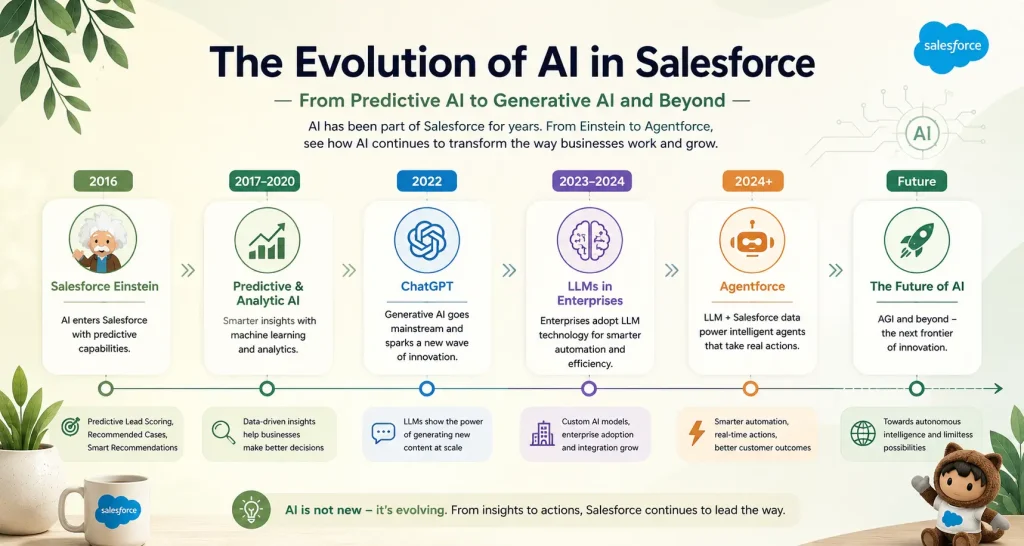
AI tools have become a regular part of modern Salesforce development, helping professionals complete everyday tasks more efficiently. From generating code suggestions to simplifying documentation, these solutions reduce manual effort and improve overall productivity across Salesforce projects.
However, artificial intelligence within Salesforce extends well beyond modern generative AI tools. Salesforce has incorporated AI capabilities for years through Salesforce Einstein, introducing features such as Predictive Lead Scoring in Sales Cloud, Recommended Case Classification in Service Cloud, and intelligent recommendations across Experience Cloud. These capabilities demonstrate that AI has long supported business processes by analyzing data and improving decision-making.
The introduction of ChatGPT significantly increased interest in generative AI because it demonstrated how large language models (LLMs) could generate content, answer questions, and assist with complex tasks. Since then, many organizations have adopted enterprise AI technologies, including Agentforce, which combines LLM capabilities with Salesforce data to help automate business operations and customer interactions.
Salesforce Agentforce Services
Artificial intelligence continues to evolve rapidly, especially with the growth of generative AI after 2022. Even so, generative AI represents just one stage in the broader evolution of AI. As Salesforce continues expanding its AI capabilities, businesses have more opportunities to improve efficiency through intelligent automation while preparing for the next generation of AI-powered innovation.
The Impact on Productivity
The biggest advantage of Salesforce AI tools and AI-driven projects is improved productivity. Whether developers are using AI during their daily development tasks or working on Salesforce AI implementation projects, the primary objective remains the same—achieving better results with less manual effort.
Tools such as Agentforce, Claude Code, and GitHub Copilot help Salesforce developers complete repetitive development tasks more efficiently. This allows them to spend more time on complex business requirements, solution design, and strategic development work that requires technical expertise.
Why AI Projects May Be Lagging Behind
Many discussions have focused on why AI adoption in business is progressing more slowly than expected. One important reason is that Salesforce developers have been working with large language model (LLM) AI much longer than most business users. A common example is ChatGPT, but its underlying technology existed well before the chatbot became widely available.
The technology behind ChatGPT is GPT (Generative Pre-trained Transformer), which was introduced years before the ChatGPT interface became available in late 2022. Earlier versions were mainly accessible through APIs, making them practical for developers rather than general users.
Developers also had access to AI-powered coding assistants like GitHub Copilot, released in 2021, which helped accelerate software development before ChatGPT became popular. Because of this early exposure, developers became familiar with AI technologies sooner than many organizations.
Another important factor behind the difference between the 90% AI tool adoption rate and the 30% AI project adoption rate is practical business value.
Developers regularly use AI tools because they have already experienced measurable productivity improvements and have seen successful real-world examples. Businesses, however, often require stronger proof before investing in large-scale Salesforce AI solutions.
Every organization has unique business processes and different requirements for implementing technologies such as Agentforce. As a result, companies usually evaluate potential business outcomes before committing to AI implementation projects.
Business leaders also expect AI investments to generate measurable returns, whether through increased revenue, operational efficiency, or improved customer experiences. Without clear business outcomes, organizations are more cautious about making significant investments in AI initiatives.
As more successful Salesforce AI projects demonstrate measurable business value, AI adoption is expected to grow further. The current percentage of AI-focused projects should be viewed as part of an evolving technology landscape rather than a limitation of AI itself.
Salesforce Integration Services
Summary
The survey findings show that Salesforce developers have widely adopted AI tools, while dedicated Salesforce AI projects are still developing at a more gradual pace. Developers continue to gain value from AI across different types of projects, even when those projects are not primarily focused on artificial intelligence.
As more businesses recognize the practical benefits of AI implementation, the number of AI-powered Salesforce projects is likely to increase in the coming years.
iBirds Services Help for your business Arrange in Salesforce Environment.
FAQs
1. Why are Salesforce developers using AI tools more than AI projects?
Many Salesforce developers use AI tools like Agentforce and GitHub Copilot to speed up coding, testing, and documentation. Building AI-powered Salesforce projects requires additional planning, business approval, and implementation effort.
2. What are AI projects in Salesforce?
AI projects in Salesforce involve implementing intelligent features such as Agentforce, AI-powered automation, custom Agent Actions using Apex, and integrations with large language models (LLMs) to solve business challenges.
3. Which AI tools are commonly used by Salesforce developers?
Salesforce developers commonly use Agentforce, GitHub Copilot, Claude Code, Cursor, and ChatGPT to improve productivity, generate code suggestions, automate repetitive tasks, and accelerate development.
4. How does AI improve Salesforce developer productivity?
AI helps Salesforce developers reduce repetitive work, generate code, review logic, create documentation, and focus more on solution architecture, business requirements, and complex development tasks.
5. Why are businesses slower to adopt Salesforce AI projects?
Many organizations evaluate business value, implementation costs, return on investment (ROI), and real-world success stories before investing in Salesforce AI projects.
6. What is the difference between AI tools and AI projects?
AI tools assist developers during daily work, while AI projects involve designing and implementing AI-powered Salesforce solutions that automate business processes and improve customer experiences.
7. How does Agentforce support Salesforce AI implementation?
Agentforce enables businesses to build AI-powered agents, automate workflows, perform intelligent actions, and use Salesforce data to improve productivity and customer engagement.
8. Is Salesforce Einstein still relevant with modern AI?
Yes. Salesforce Einstein continues to provide predictive AI capabilities such as lead scoring, case classification, and intelligent recommendations, while newer technologies like Agentforce expand AI functionality with generative AI.
9. What skills are needed for Salesforce AI development?
Salesforce AI development typically requires knowledge of Salesforce Platform, Apex, Agentforce, Flow Automation, integrations, APIs, prompt engineering, and AI-powered business process automation.
10. What is the future of AI in Salesforce?
The future of Salesforce AI focuses on intelligent automation, AI agents, predictive insights, generative AI, and business-specific AI solutions that help organizations improve efficiency and decision-making.