

Nonprofit organizations use Salesforce to manage fundraising, programs, donors, volunteers, and stakeholder relationships. The goal is to keep important information in one system and give teams a reliable view of donor activity and organizational performance. However, poor data quality can make that picture much less reliable.
Duplicate contacts can split donation histories, while outdated email addresses can reduce campaign reach and deliverability. Program information managed through spreadsheets can also create inconsistent records, while limited automation makes it harder to monitor fundraising and engagement accurately.
These issues may not seem serious when viewed separately. Together, however, they raise an important question: how much potential nonprofit revenue could be affected simply because the data inside the CRM is incomplete, outdated, or inconsistent?
For nonprofits working to improve CRM processes and data management, Salesforce Consulting Services can help align Salesforce configuration with organizational requirements.
Where “Up to 30% of Revenue” Comes From
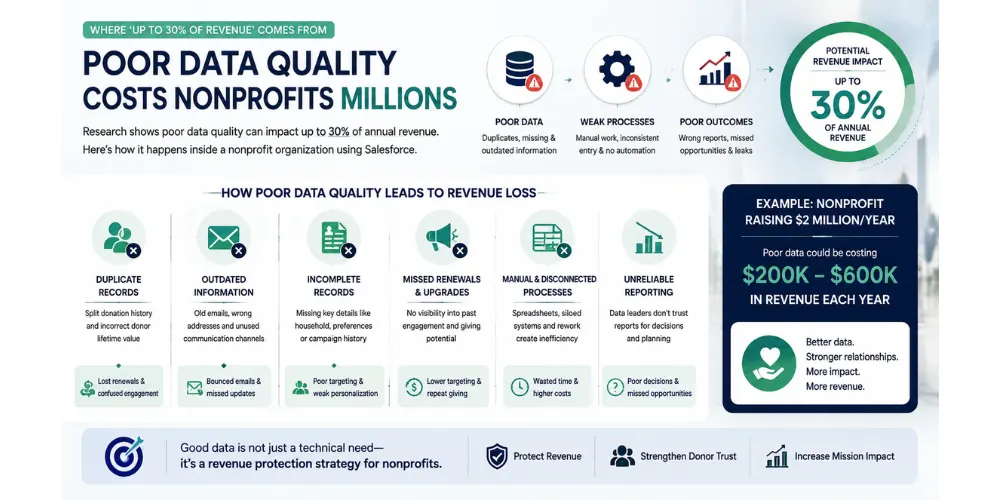
The “up to 30%” figure comes from Salesforce research on the business cost of poor-quality data. Salesforce states that poor-quality data costs businesses around $700 billion annually, or about 30% of the average company’s revenue. The same source also highlights incomplete contacts, outdated records, and duplicate data as common data-quality problems.
This figure should not be treated as a fixed revenue loss for every nonprofit. It is better understood as a potential upper limit that shows how expensive unreliable data can become when problems spread across fundraising, marketing, reporting, and customer or donor management.
Experian’s data quality research provides additional context. Its study found that U.S. organizations believed an average of 32% of their data was inaccurate, while 91% said inaccurate data affected revenue through wasted resources, lost productivity, and unnecessary marketing and communication costs. The study also reported that respondents estimated 27% of revenue was wasted because of inaccurate and incomplete customer or prospect data.
For a nonprofit raising $2 million per year, a 30% ceiling would represent a potential exposure of up to $600,000. That does not mean the organization will actually lose $600,000 because of poor data. Instead, it shows the scale of the risk created by missed renewals, incorrect campaign targeting, duplicate donor records, and wasted staff effort.
Even an impact of 10% to 15% would represent a significant amount for a nonprofit operating with limited resources. Salesforce’s 2026 data and analytics research also reports that incomplete, outdated, or poor-quality data remains the leading factor preventing organizations from becoming truly data-driven.
Nonprofits face the same data-quality challenges as other organizations, but the effect can be more noticeable because teams are often smaller and fundraising, program delivery, and stakeholder management depend heavily on accurate information.
How Bad Data Really Shows Up in a Nonprofit Org
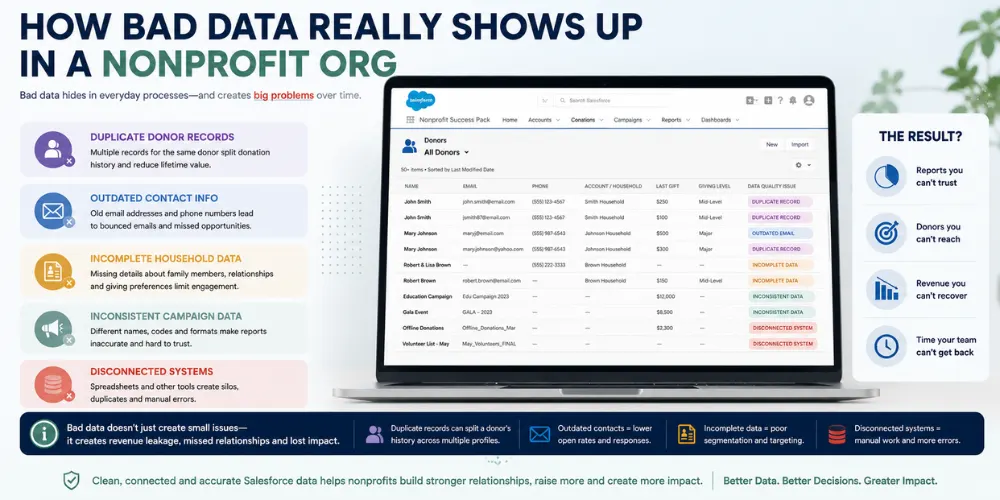
Poor data in a Salesforce nonprofit organization rarely causes one major system failure. Instead, it usually appears through many small and repeated issues that gradually affect fundraising, reporting, communication, and donor relationships.
A common example is a donor being stored under three slightly different names. This can split the donation history across multiple records, making the donor’s total contribution appear lower than it really is. Households can also be tracked inconsistently, causing donor retention reports to differ from financial records. Annual campaigns may also use lists containing old or rejected email addresses, reducing deliverability and response rates over time.
Salesforce’s nonprofit data guidelines on Trailhead treat data as an important organizational asset. The focus is not simply on importing records into Salesforce, but on maintaining reliable data that supports stakeholder experiences, reporting, and business decisions.
For nonprofits managing marketing and donor communication, Pardot can support structured marketing automation and help teams manage campaign communication using more consistent customer and prospect data.
How Salesforce Can Fix (or Aggravate) the Problem
Salesforce’s flexibility means it can either increase the impact of poor data or help organizations control it. Every automation, report, and campaign built on inconsistent information can carry those problems forward. For example, donation journeys may miss important supporters because their records are duplicated, upgrade campaigns may fail to reach the correct households, or grant reminders may be assigned to the wrong owner because important relationships are missing.
Salesforce also provides tools and practices for improving data standardization and management. Salesforce recommends creating a data governance strategy and framework that includes clear rules for data entry and consistent data standards. (salesforce.com)
For nonprofits, this creates an important operational question: should data quality be managed as a shared organizational responsibility, or should each team manage its own records independently?
Reducing Risk by Leaning on NPSP’s Standard Model
For organizations using Nonprofit Success Pack or Nonprofit Cloud, the standard data model can reduce the hidden cost of poor data when it is implemented according to Salesforce best practices. NPSP’s family account model provides a consistent way to represent individuals, families, organizations, and their donations. Recurring donations and campaigns can also be tracked for more reliable reporting without relying on unnecessary custom objects.
Salesforce’s nonprofit implementation guidance emphasizes using standard objects and models where possible because standardization can make data governance, maintenance, and cleansing easier. A consistent structure also gives teams clearer rules for entering and managing donor information.
Duplicate detection rules and processes provide another important layer of protection. Salesforce research on data quality highlights how incomplete and duplicated contact records can create significant business costs. For nonprofits, this is especially important because donor management and accountability depend on accurate records.
A donor record containing a reliable email address, preferred communication channel, household information, and campaign history can support much better segmentation and reporting than a record containing only a name and one donation. For organizations connecting Salesforce with other systems, MuleSoft can help integrate data across business applications and reduce disconnected information.
A Real Case Scenario for a $2M per Year Nonprofit
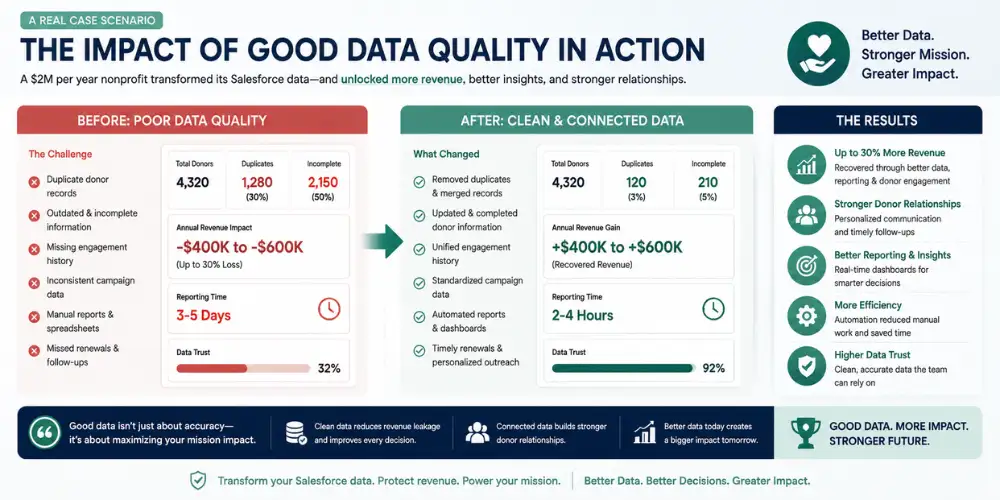
Consider a nonprofit that raises $2 million annually. Initially, its Salesforce organization contains thousands of duplicate contacts, incomplete addresses, and inconsistent campaign statuses. Financial and fundraising information is also stored differently across systems, making management hesitant to rely on CRM reports for board-level decisions.
After a year of focused data quality work, the situation can look very different. The organization follows the NPSP model, establishes basic data governance, and activates duplicate detection rules to identify overlapping records. Core processes, such as entering donations and registering volunteers, are managed through Screen Flows that enforce required fields and consistent values. Campaign lists are cleaned regularly, while email bounces are managed systematically to improve deliverability and segmentation. Reports used in management meetings also align more closely with financial records, reducing the time spent checking discrepancies.
Under these conditions, recovering approximately 10% to 15% of previously hidden or lost revenue can be possible through fewer errors, stronger data controls, better targeting, and less wasted effort. The “up to 30%” figure should therefore be treated as a potential ceiling rather than a forecast. Each organization needs to measure its own data problems and improve its processes using appropriate Salesforce practices.
Final Thoughts
Salesforce research and data quality studies point to the same issue: poor data is more than an untidy CRM. Duplicate records, incomplete information, inconsistent processes, and limited automation can affect nonprofit fundraising, reporting, communication, and stakeholder management.
The Salesforce platform can provide a structured way to address these problems when its data models, automation, and governance practices are used correctly. NPSP and Nonprofit Cloud provide standardized models, while Flows can automate data-related processes and enforce required information. Salesforce nonprofit guidance can also provide a practical framework for organizations with smaller teams.
For nonprofits that also manage operational resources alongside fundraising and programs, Enterprise Resource Planning Services can support connected business processes and data management.
The key point is simple: ignoring data quality can mean accepting avoidable revenue losses.
Treating data as shared infrastructure can turn Salesforce from a passive record system into a platform that supports better fundraising, reporting, and operational decisions. For nonprofits where every donation, grant cycle, and campaign matters, improving data quality is an important part of responsible Salesforce management.
Frequently Asked Questions
1. How does poor data quality affect nonprofits?
Poor data quality can create duplicate donor records, incomplete information, incorrect reports, and missed communication opportunities. These issues can affect fundraising, donor retention, and operational efficiency.
2. Can poor Salesforce data quality reduce nonprofit revenue?
Yes. Inaccurate or incomplete data can contribute to missed renewals, incorrect campaign targeting, duplicate records, and wasted marketing efforts. The actual financial impact depends on the organization’s data quality and processes.
3. What causes poor data quality in Salesforce for nonprofits?
Common causes include duplicate contacts, outdated email addresses, inconsistent data entry, incomplete records, disconnected systems, spreadsheet-based processes, and limited automation.
4. How can nonprofits improve Salesforce data quality?
Nonprofits can improve data quality by establishing data governance rules, standardizing data entry, detecting duplicate records, cleaning outdated information, and using automation to enforce required fields and consistent values.
5. What is NPSP and how does it help nonprofits?
The Nonprofit Success Pack (NPSP) provides a Salesforce data model designed for nonprofit organizations. Its account and relationship structure can help organizations manage households, individuals, donations, and campaigns more consistently.
6. How do duplicate Salesforce records affect nonprofit fundraising?
Duplicate records can split a donor’s contribution history across multiple records. This can make donor lifetime value appear lower, affect segmentation, create duplicate communications, and reduce the accuracy of fundraising reports.
7. Can Salesforce automation improve nonprofit data quality?
Yes. Salesforce Flows can automate data-related processes and require users to provide important information before records are created or updated. This can help reduce incomplete and inconsistent records.
8. Is the 30% revenue loss figure applicable to every nonprofit?
No. The 30% figure should not be treated as a guaranteed revenue loss for every nonprofit. It is better viewed as a potential ceiling that illustrates the possible business impact of poor-quality data.